I found myself standing at the edge of an abandoned lake that afternoon, staring into water so clear it almost felt unnatural. The surface was unusually still, reflecting the sky like a flawless mirror, broken only by faint ripples caused by a light breeze passing through the surrounding trees. There was something unsettling about the silence of the place, as if the entire environment had been paused in time. The lake had always carried a quiet reputation among locals, often described as remote and rarely visited.
Dense woodland surrounded it on all sides, forming a natural barrier that made the area feel isolated from the rest of the world. On that particular day, however, curiosity led me off the path and toward the shoreline, unaware that I was about to misinterpret something completely ordinary in the most dramatic way possible. An Unusual Pattern Beneath the Water. As I stepped closer, I noticed something strange beneath the surface of the lakebed.
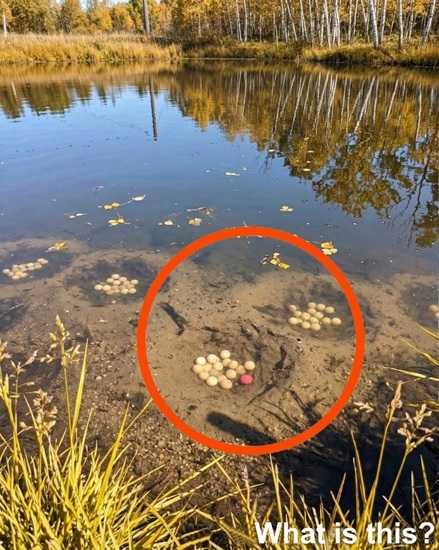
Scattered across the mud were dozens of round, perfectly shaped objects. From a distance, they appeared almost artificial, arranged in loose clusters that seemed too organized to be random. The sunlight filtering through the water made them glimmer faintly, enhancing their strange and unsettling appearance.
My first instinct was confusion, followed quickly by curiosity. The shapes did not resemble rocks or natural debris. Instead, they appeared smooth and uniform, almost manufactured. The isolation of the location and the eerie stillness of the water made the sight feel even more mysterious, as if I had stumbled upon something hidden for a long time.

Growing Curiosity and Rising Imagination
The longer I stood there, the more my imagination began to take over. I found myself questioning what I was really looking at. Could these objects be remnants of something ancient, perhaps preserved under layers of sediment for decades or even centuries? Or was there a more unusual explanation, something connected to human activity that had simply gone unnoticed?
Every possibility seemed to branch into another, each one more uncertain than the last. The human mind has a tendency to fill gaps in understanding with narratives, and in that moment, my thoughts were no different. The quiet surroundings only intensified the effect, turning curiosity into a deep sense of unease mixed with fascination.
Approaching the Shoreline
Despite the hesitation I felt, I slowly moved closer to the edge of the lake. The ground beneath my feet became softer, damp soil giving way to wet mud that shifted slightly with each step. I focused my attention on one particular cluster of the round objects that was more visible than the others, partially exposed where the water was shallow.
From this closer perspective, the shapes still looked unusual, but something subtle began to change in how I perceived them. The surface texture was not entirely smooth, and faint patterns started to become visible. Still, I could not immediately identify what I was seeing, and my mind continued to search for explanations that matched the dramatic impression I had formed at first glance.
The Moment of Realization
It was only when the light shifted slightly and struck one of the objects directly that the illusion finally broke. The surface revealed a familiar texture—small dimples evenly spread across the material. In an instant, the mysterious and almost otherworldly interpretation collapsed into something far more ordinary.
What I had been observing were not ancient artifacts, nor anything unnatural or unknown. They were golf balls, dozens of them resting in the mud at the bottom of the lake. Waterlogged and stained over time, they had lost their bright white color and taken on the appearance of something far more mysterious when viewed from a distance.
Understanding the Reality Behind the Mystery
The realization brought an immediate shift in emotion. What had moments earlier felt tense and mysterious was suddenly replaced with relief and a quiet sense of embarrassment. The explanation was simple: the lake was likely situated near a golf course or driving range, and over time, stray shots had ended up in the water, gradually accumulating on the lakebed.
The strange patterns I had noticed were not intentional arrangements but rather the natural result of objects settling into soft sediment. What looked organized from afar was nothing more than chance and repetition over time, shaped by gravity and the lake’s uneven bottom.
Reflection on Perception and Imagination
Standing there, I couldn’t help but reflect on how easily perception can be influenced by environment and expectation. In an unfamiliar and isolated setting, the mind tends to amplify uncertainty, transforming simple objects into something far more dramatic. What I experienced was not a discovery of something unknown, but rather a demonstration of how quickly imagination can outpace reality.
This moment served as a reminder that human perception is not always a reliable interpreter of the world. We often construct meaning before we fully understand what we are seeing, especially when we are alone or in unfamiliar surroundings. The brain naturally seeks patterns, even when none are intentionally present.
Walking Away From the Lake
After spending some time observing the lakebed, I eventually turned away and began walking back through the trees. The water behind me returned to its original appearance—calm, reflective, and completely ordinary. There was no mystery left, only the quiet presence of a forgotten corner of nature being slowly filled with small, everyday objects over time.
I left the golf balls where they were, resting in the sediment like silent reminders of misdirected shots and unnoticed journeys beneath the surface. The earlier sense of intrigue had faded completely, replaced by a calm understanding of what I had actually seen.
A Lasting Lesson in Perspective
Even though the experience turned out to have a simple explanation, it stayed with me longer than expected. It highlighted how easily curiosity can transform into assumption, and how assumption can build entire narratives that feel real in the moment. The emotional intensity of discovery does not always depend on the truth of what is found.
In the end, the lake was not hiding a secret or mystery. It was simply a place where everyday objects had collected over time, misunderstood at first glance but entirely ordinary upon closer inspection. And yet, the journey from confusion to clarity was valuable in itself, reminding me that not every strange sight is a hidden wonder—sometimes it is just the world being quietly, predictably itself.
