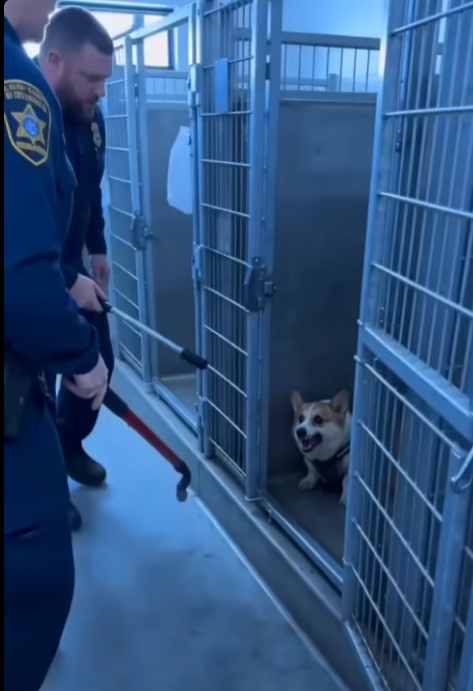
The bold red stamp on the clipboard didn’t leave room for interpretation, and for the staff working that morning, it represented another difficult but routine decision in an overcrowded municipal shelter. In one of the back isolation runs, a small Pembroke Welsh Corgi—listed only as Tag #842—sat trembling against the metal wall, his short legs tucked tightly beneath him. To most of the staff, he was considered unmanageable. He had snapped at handlers during intake, barked aggressively whenever someone approached, and refused every attempt at examination.
The consensus had become grimly simple: he was too dangerous to adopt out, and too stressed to rehabilitate. But veterinary technician Sarah Collins couldn’t accept that conclusion so easily. She had worked in shelters long enough to recognize the difference between true aggression and fear disguised as aggression. What she saw in the Corgi wasn’t calculated hostility—it was panic. Every reaction seemed reactive rather than intentional, like a living being cornered by something he didn’t understand.
As the morning hours ticked closer to the scheduled procedure, Sarah requested one final evaluation. When she entered the isolation corridor, the fluorescent lights flickered above her, casting uneven shadows across the concrete floor. The Corgi immediately pressed himself backward, his body flattening against the wall as far as it would go. That was when she noticed something no one had documented properly in the intake report: a heavy, oversized black tactical harness wrapped tightly around his small frame.
It didn’t belong to a typical pet.
The material was military-grade—reinforced stitching, multiple attachment points, and worn Velcro patches dulled by dirt and weather exposure. It looked like equipment designed for working dogs in field operations, not a shelter intake animal. The harness was secured too tightly in some places and unevenly in others, as though it had been adjusted under pressure or in urgency.
What struck Sarah most was how the dog behaved around it.
He wasn’t trying to escape the room.
He was protecting the harness.
Every time she moved closer, he shifted his body to block access to it, pressing his chest down and turning slightly to shield the front pouch from view. It was not the behavior of a dog guarding himself—it was the behavior of a dog guarding something else.
At first, Sarah assumed there might be an untreated injury beneath the gear. A tumor, a wound, or some kind of trauma could explain both the aggression and the protective stance. That possibility alone was enough to justify stopping the euthanasia order, at least temporarily.
She radioed the attending supervisor and asked for ten minutes.
Approaching slowly, she crouched a few feet away, speaking in a calm, steady voice. The Corgi growled softly, not with confidence, but with exhaustion. It sounded like a warning he wasn’t sure he could maintain. Inch by inch, Sarah reduced the distance between them, careful not to trigger another panic response.
When she finally reached the harness, her hands hesitated.
The dog tensed immediately.
But he didn’t bite.
Instead, he closed his eyes and trembled, as if bracing for something inevitable.
That hesitation gave her enough confidence to continue.
As she ran her fingers along the outer pouch, she felt something unusual—an uneven shape, soft at certain points, shifting slightly when pressure was applied. It wasn’t rigid like a tumor or injury site. It moved.
Sarah froze.
Then she felt it again.
A faint motion from inside the pouch.
Her breath tightened as she carefully unfastened the buckle and opened the compartment.
What she saw inside stopped her completely.
A tiny newborn kitten, no larger than her palm, curled tightly within the fabric lining.
It was barely alive. Its eyes were sealed shut, its body cold and weak, its breathing shallow and irregular. It had likely been there for hours, maybe longer, protected only by the warmth of the harness and the body of the dog carrying it.
Suddenly, everything about the Corgi’s behavior changed meaning.
He wasn’t aggressive.
He wasn’t unstable.
He was protecting something fragile with every ounce of strength he had left.
The growling, the snapping, the refusal to be handled—all of it had been defense, not hostility. He had been guarding the kitten from anyone he perceived as a threat, even while injured and exhausted himself.
As Sarah gently lifted the kitten out, the Corgi immediately shifted forward. His posture changed completely. The tension in his body softened, replaced by alert concern. He leaned in carefully, sniffing the kitten, nudging it lightly as if confirming it was still alive.
For the first time since his arrival, he looked less like a frightened animal and more like a guardian finally allowed to rest.
Shelter staff who arrived moments later stood in stunned silence. The dog they had labeled dangerous was now sitting calmly beside the kitten, watching every movement with quiet focus.
But the discovery didn’t end there.
As Sarah fully removed the harness to examine the Corgi’s condition, she noticed something far more serious. Beneath the dense fur on his chest was a deep, partially scabbed wound. Blood had been slowing, not because the injury was minor, but because the tight harness had been unintentionally compressing the area, acting almost like a crude pressure bandage.
The moment it was loosened, his breathing changed.
And then he collapsed.
Emergency intervention began immediately.
While one team worked on stabilizing the Corgi, another focused on the kitten, which was rushed into warming treatment and neonatal care. The situation had shifted from a euthanasia procedure to a dual emergency rescue within minutes.
As staff carefully inspected the discarded harness, they made another unexpected discovery.
Inside a hidden inner pocket was a military identification card.
The name on the card belonged to Captain James Sterling.
The shelter director, who had been notified of the situation, went pale upon hearing it. That name was not unfamiliar to her—it belonged to her son, a military officer who had gone missing during severe flooding days earlier after his vehicle was reported lost near a collapsed roadway.
Search and rescue teams had found no trace since.
The realization changed everything.
The Corgi, now identified as Barnaby, was not a stray or abandoned pet. He was a trained military working dog assigned to Captain Sterling.
Investigators later pieced together a likely sequence of events. During the flooding incident, the vehicle had crashed, and both man and dog had survived the initial impact. Despite severe chest injuries, Barnaby had managed to move through dangerous terrain. At some point during that ordeal, he had encountered the newborn kitten—likely separated from its own environment—and, in an act of instinctive protection, carried it within the only secure space he had: the tactical harness.
Even while injured, he continued to move, carrying both the kitten and the identification that would eventually lead rescuers back to his handler.
That single act of endurance became the key to everything.
Using the location data and environmental clues connected to the harness, rescue teams were able to narrow their search radius significantly. Within hours, they located Captain Sterling alive, though severely injured and in urgent need of medical evacuation.
Against overwhelming odds, both lives connected to Barnaby were saved.
The kitten survived.
The captain survived.
And the dog once labeled “too dangerous” had unknowingly become the bridge between life and death.
Days later, after surgery and stabilization, Barnaby was brought into the recovery ward where Captain Sterling was also being treated. The reunion was quiet at first. The captain could barely move, but when Barnaby was brought into the room, everything changed.
The dog didn’t bark or panic.
He simply went still for a moment—then moved forward carefully, pressing his head against his owner’s hand.
What followed was a long silence filled with understanding rather than words.
Shelter staff who witnessed the moment later described it as one of the most powerful experiences of their careers. The animal they once feared was now recognized for what he had always been: a loyal partner carrying an impossible burden alone.
Barnaby’s story became a lasting lesson for everyone involved.
Not all aggression is violence.
Not all fear is danger.
And sometimes, the beings we rush to judge are the ones silently holding everything together until help finally arrives.
