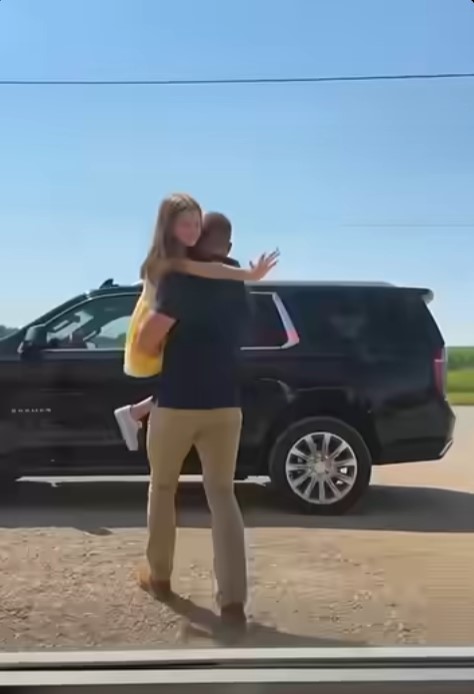
John Miller had never fully left the habits he learned in the United States Marine Corps. Even years after returning to civilian life, his awareness remained sharp in a way that most people would consider excessive. He noticed patterns in behavior, subtle changes in tone, and the kind of details that often went ignored in crowded public spaces. On an ordinary afternoon in Jacksonville, North Carolina, these instincts would quietly pull him into a situation that would later change multiple lives.
He was sitting alone in a small roadside diner, half-listening to the clatter of dishes and low conversation around him, when a black SUV pulled into the parking lot. At first, it was nothing remarkable. Expensive cars were not unusual in the area, and people came and went constantly. But something about the timing and the way the vehicle stopped caught his attention. The driver paused longer than necessary before stepping out, as if carefully controlling the situation rather than simply arriving at a destination.
A man in a tailored suit exited the SUV and opened the passenger door. He guided a young girl out of the vehicle, holding her arm in a way that seemed firm rather than comforting. The man’s expression was calm and controlled, wearing a practiced smile that suggested authority and familiarity. The girl, later identified as Maya, kept her eyes down and clutched a blue sketchbook tightly against her chest. She did not speak, and she did not look around. That silence, more than anything else, unsettled John.
Inside the diner, the man introduced himself casually to staff as Richard Vance, a local real estate developer. His voice carried confidence, and he appeared polite, even charismatic in a public setting. Yet John observed something different in the way he interacted with the child when he thought no one was watching. His posture shifted slightly, his tone tightened, and his attention never fully left her. Maya, meanwhile, reacted to even the smallest movements, as though constantly anticipating instructions or consequences.
John’s focus narrowed as he watched the pair take a booth across the room. Maya sat very still, her shoulders slightly raised, her hands resting protectively over her sketchbook. She did not engage with the menu or the environment around her. Instead, her gaze occasionally drifted toward the exit, then quickly away again. The behavior was subtle, but to someone trained to read stress responses, it stood out clearly.
At one point, Richard stepped away from the table to take a phone call near the entrance. The moment he turned his back, Maya’s behavior changed. She slowly looked across the diner, scanning faces, until her eyes landed on John. For a brief moment, they made direct eye contact. She hesitated, then subtly lowered one hand beneath the table. With controlled precision, she formed a gesture: an open palm, thumb tucked inward, fingers folded down over it.
John recognized the signal immediately. It was a widely known silent distress gesture designed to indicate a request for help in situations where speaking openly might be dangerous. His training took over, but so did caution. He did not react outwardly. Instead, he remained still, giving no indication that he understood what she had communicated. The importance of not escalating the situation in public was clear.
When Richard returned, Maya quickly withdrew her hand and resumed her previous posture. Moments later, he finished their meal abruptly and guided her out of the diner. The movement felt rushed, controlled, and deliberate. As they exited, Maya’s grip on her sketchbook tightened further, and she briefly dropped it near the doorway. Richard’s expression shifted for a split second—an almost imperceptible flash of irritation—before he continued toward the SUV.
John waited only long enough to ensure he was not directly observed before deciding to follow. He maintained a safe distance, careful not to draw attention as he tracked the vehicle through the streets and eventually out toward a quieter rural area. The further they traveled, the more isolated the surroundings became, transitioning from residential zones to wooded roads with fewer landmarks and less visibility.
Eventually, the SUV turned onto a private gravel path leading toward an old property near the outskirts of town. From a concealed position at the edge of the tree line, John observed the area. There was a partially constructed house and an older structure that appeared to be a cabin or storage building. Another vehicle was parked nearby, partially hidden from view. That second car suggested the presence of another adult, later identified as Sarah, the girl’s mother.
From a distance, John could see movement inside the cabin. At one point, Maya appeared briefly at a window covered with dark plastic sheeting, her silhouette faint against the dim interior light. She seemed to be watching the outside, almost as if hoping someone had followed her. The scene confirmed to John that this was not a misunderstanding or a routine family disagreement. Something was clearly wrong.
He contacted a trusted former colleague, Marcus, who began quietly gathering background information. What they uncovered raised additional concerns about Richard Vance’s history, including previous legal disputes and questionable incidents reported in connection with his personal relationships. None of it alone was definitive, but together it formed a pattern that warranted closer attention.
The situation escalated when John heard a scream from inside the cabin. Without waiting for backup, he moved quickly toward the structure. Inside, he found Sarah injured and visibly distressed, while Richard stood nearby holding documents that appeared to involve property or legal transfers. His tone suggested pressure and urgency rather than concern for the situation unfolding around him.
John instructed Maya to move to a separate room and stay out of sight. His priority was de-escalation and safety. Richard reacted aggressively, attempting to assert control verbally, but the confrontation escalated rapidly. Within moments, John physically intervened to prevent further harm until authorities could arrive. The situation was contained shortly afterward when law enforcement and emergency responders reached the property.
Deputy Tom Reynolds and Detective Frank Gallow were among the first officers on the scene. Paramedics provided immediate care to Sarah, who initially attempted to minimize what had happened, insisting she had fallen. However, the nature of her injuries and the surrounding circumstances led investigators to continue examining the situation more closely.
In the following hours, additional context emerged. Maya, though traumatized and quiet, had kept her sketchbook with her at all times. Inside were drawings that depicted individuals, locations, and events that provided investigators with new leads. While not formal evidence on their own, they helped guide the direction of the inquiry and supported further investigation into Richard’s background.
Sarah was transported for medical treatment and stabilized. Richard was taken into custody as authorities began reviewing prior complaints and financial records connected to his activities. The case expanded as investigators worked to understand the full scope of what had occurred.
In the hospital, after a long period of silence and recovery, Maya finally spoke again. Sitting beside her mother, she quietly said the word “Mommy” for the first time since the incident began. It was a small moment, but one that carried immense emotional weight for those present. Sarah, overwhelmed with relief, held her daughter tightly.
John remained nearby, observing quietly from a distance. The situation that had begun with a subtle gesture in a diner had ultimately led to intervention before further harm could occur. The experience reinforced a lesson he had learned long ago: that awareness, even in ordinary moments, can make a decisive difference.
Maya’s earlier hand signal had been simple, almost invisible to anyone not paying attention. Yet it had communicated fear in a way words could not. It was a reminder that danger does not always announce itself clearly, and that sometimes the smallest signs carry the greatest importance.
As time passed, the case continued through the legal system, and the full investigation expanded further. For John, however, the most lasting memory was not the confrontation itself, but the quiet moment of recognition in the diner when a child silently asked to be seen.
