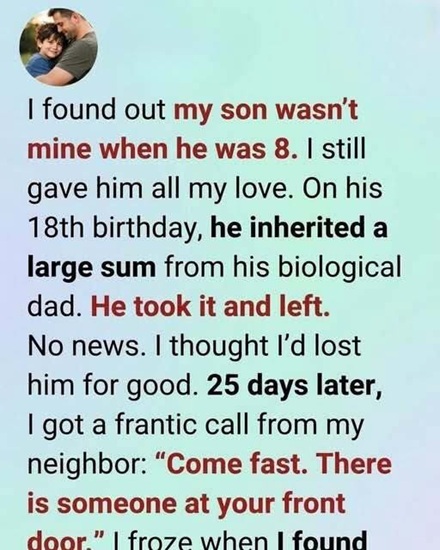
Some moments don’t announce themselves. They don’t arrive with dramatic music or obvious signs that something important is about to unfold. Instead, they slip into ordinary days quietly, disguised as routine, and only later do you realize that your life moved in a different direction without warning. For me, that moment came during what was supposed to be a completely normal medical visit with my son. He was eight years old at the time. Nothing about that day felt unusual.
It was just another appointment scheduled between school, work, and the predictable rhythm of everyday life. A short check-in, a few questions, and then back home. That’s what I expected. But expectations can change in ways you don’t notice right away. At first, everything seemed routine. The doctor asked standard questions, the kind you answer without thinking. But then the conversation slowed. More questions followed. Then tests that were not part of the original plan.
The atmosphere in the room began to shift in a way that was subtle but impossible to ignore. It felt like something unspoken was gathering weight between each sentence. What I remember most is the silence between those moments. The doctor’s pauses grew longer. Words were chosen more carefully. Even the smallest sounds in the room felt amplified. The clicking pen, the rustle of paper, the faint hum of machines outside the door—all of it became strangely noticeable. It was as if time itself was hesitating, waiting for something important to be said.
And then it was said. Not with drama. Not with urgency. Just a simple, carefully delivered truth. We were told we were not biologically related. For a moment, I didn’t react. There was no visible emotion, no immediate shock. Just stillness. A quiet pause where my mind seemed to step back and observe everything from a distance, as if the moment belonged to someone else.
I looked at my son. He was sitting there swinging his legs, completely unaware that anything had changed. His attention was elsewhere, his world still intact. When he reached for my hand, it was automatic—natural, familiar, unthinking. To him, I was exactly who I had always been. And in that moment, I understood something clearly.
Whatever truth had just been revealed, it did not rewrite the years that came before it. It did not erase bedtime stories, school mornings, scraped knees, or laughter shared over simple things. Those moments were not dependent on biology. They existed because they had been lived. I was still his father. Not because of genetics.
But because of everything that had happened between us. Life didn’t change dramatically afterward. There was no sudden break or visible shift in our daily routine. The years continued in the same way they always had—structured around school, meals, conversations, and the quiet repetition of simply being present for one another. I showed up for everything.
School events, medical visits, homework frustrations, and small achievements that seemed insignificant to the outside world but meant everything in the moment. I was there when he was sick, when he was excited, when he was confused, and when he simply needed someone to sit beside him without saying anything at all.
None of that required biology. It required consistency. It required choice. At some point, I made a decision that I didn’t feel the need to announce. I would not treat the truth as something that changed our relationship. I would not let it become a barrier between us. It remained in the background, known but unspoken, like something placed carefully on a shelf and never disturbed.
So I stayed silent. Years passed. He grew older. And life continued to build itself around us in ordinary, unremarkable ways that actually meant everything. Then he turned eighteen. And everything shifted again.
This time, the truth returned in a different form. It came through legal documents and inheritance matters connected to the man who was biologically his father. A past life intersecting with our present, bringing forward questions that had never needed answers before. He came to me with it.
He wasn’t angry. He wasn’t confused in the way I feared he might be. Instead, he seemed thoughtful, like someone standing at the edge of a story trying to understand its missing pages. He wanted to know more.
Not to replace anything. But to understand himself more completely. I listened carefully, and I didn’t try to stop him. Some parts of life cannot be protected from exploration. Some questions need to be asked, even if they lead to uncertain places. “I support you,” I told him. And I meant it without hesitation.
There was no argument between us. No emotional breaking point. Just an understanding that this was something he needed to do for himself, even if it meant stepping away for a while.
When he left, the house changed in quiet ways.
Not dramatically. Not emptily in an obvious sense. But noticeably. The routines stayed, yet they felt different. Meals were quieter. Evenings stretched longer. Small sounds became more noticeable in the absence of his presence.
Time felt slower.
I didn’t know how long it would take.
So I waited.
Not with expectation, but with acceptance. Some processes in life cannot be rushed. Identity is one of them. Understanding is another. People need time to connect pieces of their own story.
Then one evening, there was a knock at the door.
I didn’t need to guess who it was.
When I opened it, he was standing there. Older. Calmer. Something had settled in him that wasn’t there before. He looked like someone who had walked through questions and come out with at least part of his answer.
He stepped forward and hugged me.
No hesitation. No distance.
Just familiarity.
“I needed to understand,” he said quietly.
I nodded.
“And did you?” I asked.
He paused for a moment, thinking carefully about his answer.
“It changed something,” he said. “But not what I thought it would.”
I waited.
“Knowing where I come from matters,” he continued. “But it doesn’t define me.”
Then he looked at me.
“And you,” he said. “You’re still the one who stayed.”
Those words carried more weight than anything else in that conversation.
Because that is what time had proven.
Family is not a single fact.
It is not a document. Not a test result. Not a definition written in biology.
It is built slowly, over years of presence, repetition, and choice. It grows in everyday moments that seem small but accumulate into something unbreakable. It is formed when someone decides, again and again, to stay.
Biology explains origin.
But belonging is something else entirely.
And in the end, it is belonging—not origin—that defines a family that lasts.
