An ordinary trip to the local grocery store is one of the most routine activities in modern life. People move through brightly lit, climate-controlled aisles with quiet confidence, selecting neatly packaged meats, cheeses, and processed foods from polished shelves. There is an unspoken trust in food labeling, industrial hygiene standards, and global supply chains that everything available for purchase has been carefully inspected and prepared for safe consumption. Most of the time, this trust goes unquestioned, as shopping becomes just another predictable part of daily life.
For one shopper, however, this ordinary experience took a sharp and unexpected turn. What began as a simple craving for a familiar breakfast item quickly became a moment of confusion and discomfort. After returning home from the supermarket, they unpacked their groceries, prepared their kitchen, and reached for a freshly sealed pack of bacon. The intention was simple—cook a quick meal and continue the day as usual, without any thought that anything unusual could occur.
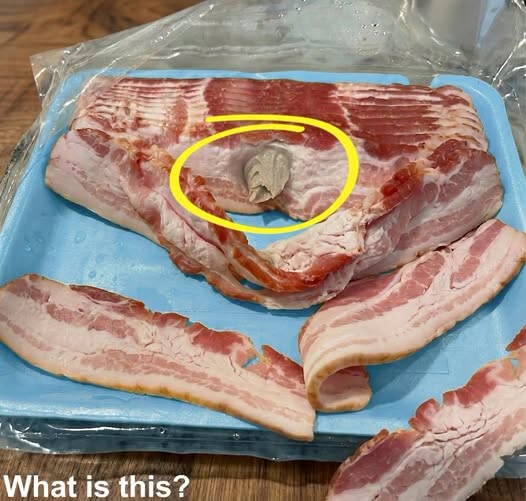
As the packaging was opened and the slices were laid out, the shopper immediately noticed something strange. Among the familiar layers of meat and fat, there appeared to be a dense, pale, and unusually firm section that did not match the surrounding texture. It stood out visually, breaking the expected uniformity of the product. In that moment, uncertainty replaced routine, and curiosity quickly turned into concern.
Standing in a quiet kitchen, the shopper examined the object more closely. Its appearance was irregular compared to the rest of the bacon, with a firmness and shape that seemed out of place. The mind, trying to make sense of something unexpected, naturally began searching for explanations. In situations like this, people often think of contamination, processing errors, or packaging issues, especially when dealing with industrial food products that pass through multiple stages of production.
As concern grew, so did imagination. Thoughts of factory machinery, automated cutting lines, and packaging systems all came to mind. It is common for consumers to associate unfamiliar textures in processed food with mistakes in production, even when such occurrences are extremely rare. This reaction is a natural psychological response when something appears outside of expectation, particularly in something as sensitive as food.
Unable to ignore the uncertainty, the shopper turned to online research. They compared images, read consumer discussions, and looked through various explanations from food safety sources. In many cases, similar concerns raised by others had already been addressed by professionals in food production and veterinary science. What initially appeared alarming often turned out to be a natural part of animal anatomy rather than an external contaminant.
Eventually, the explanation became clearer. The unusual section observed in the bacon was identified as cartilage, a firm connective tissue naturally found in animals. Cartilage is a normal biological structure that supports joints and certain areas of the body. During large-scale industrial processing, meat is separated and sliced mechanically, and on rare occasions, small sections of connective tissue may remain within packaged cuts.
From a scientific and food safety perspective, this discovery did not indicate any danger. Cartilage is not harmful when consumed and is considered a natural component of meat products. Food processing systems are designed to remove most non-muscle tissues, but due to the scale and speed of production, small variations can occasionally remain. These rare instances are not signs of contamination but rather a reflection of biological complexity in raw materials.
Even after understanding the explanation, the emotional reaction did not immediately disappear. The initial shock had already created a strong impression, and the realization that the object was natural rather than artificial did little to completely erase the discomfort. This response highlights how perception plays a powerful role in how people experience food, especially when confronted with unexpected textures or appearances.
The incident also reflects a broader reality of modern food consumption. Most people are far removed from the original form of the food they eat. Meat products are typically processed, trimmed, packaged, and presented in standardized forms that hide much of the biological structure they come from. This separation creates a sense of cleanliness and predictability, but it also means that many consumers rarely encounter the raw, unaltered reality of animal anatomy.
In industrial food production, efficiency and consistency are key priorities. Animals are processed at large facilities where mechanical systems divide and prepare meat for distribution. The goal is to create uniform products that meet consumer expectations in appearance and texture. However, because the source material is biological, complete uniformity is not always possible, and small natural variations can occasionally appear.
For the shopper, the experience became more than just a moment of surprise. It served as a reminder of how distant everyday life is from the origins of the food supply. In a modern environment where packaging and branding shape perception, it is easy to forget that food originates from complex living organisms that undergo extensive processing before reaching store shelves.
Although there was no safety risk involved, the experience left a lasting impression. It highlighted how quickly assumptions can be challenged when something unexpected appears in an otherwise familiar routine. It also demonstrated how strong the psychological reaction to food irregularities can be, even when the explanation is completely harmless and natural.
In the end, the bacon itself was entirely safe for consumption, and there was no defect in the product. The moment of confusion was resolved through simple research and clarification. However, the experience remained memorable, not because of danger, but because it disrupted the usual sense of distance between consumer and source.
Ultimately, this small incident illustrates a larger truth about modern life. Much of what we consume is shaped by complex systems that operate behind the scenes, far removed from daily awareness. And sometimes, when those systems briefly reveal their natural origins, even in the smallest way, they can change how we perceive something as simple and ordinary as a meal prepared in our own kitchen.
