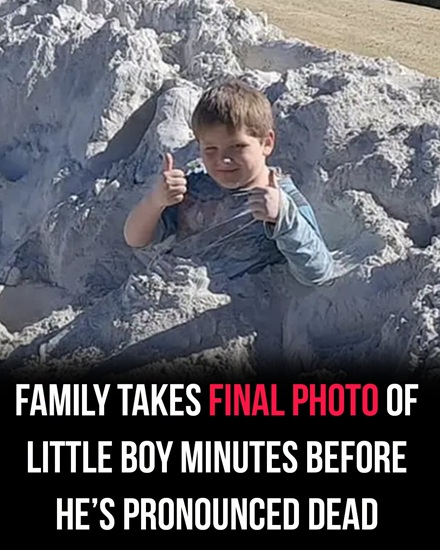
A heartbreaking image has drawn widespread attention online, showing the final moments of 7-year-old Arthur Emanuel Bitencourt, a joyful child from Brazil whose life ended tragically just minutes after the photo was taken. The image, which later circulated on social media, shows him smiling brightly and giving a double thumbs-up, completely unaware of the danger surrounding him. What appeared to be a harmless moment of childhood play turned into a devastating reminder of how quickly ordinary situations can become life-threatening.
The incident took place near the family’s home in the neighborhood of Ipiranga, in the southern Brazilian state of Paraná. Arthur had been playing outside when he encountered a pile of white powder near the roadside. To him, it looked like soft sand—something children often find appealing for play and imagination. However, the substance was later identified as limestone powder, a material commonly used in construction work but not safe for unprotected human exposure.
Limestone powder is widely used in building materials such as cement, bricks, and concrete. While it plays an important role in construction, it is not harmless when handled improperly. When inhaled, fine particles can irritate the respiratory system and, in some cases, cause serious health complications. Children, due to their smaller airways and developing lungs, are especially vulnerable to such exposure. Unfortunately, Arthur was unaware of these dangers at the time.

Shortly after playing in the powder, Arthur began to feel unwell. His condition worsened rapidly, prompting his family to rush him to a nearby hospital. Despite medical efforts, doctors were unable to save him, and he was pronounced dead shortly after arrival. The suddenness of the event left his family in shock, struggling to understand how a simple moment of play could lead to such a tragic outcome.
Following the incident, Arthur’s uncle, Romaldo Bitencourt, shared the now-viral photograph on social media. He described it as both a tribute to his nephew and a warning to other families. In his message, he expressed deep sorrow and emphasized how quickly everything had changed. His words reflected the pain of a family trying to cope with an unimaginable loss while also hoping to prevent similar tragedies from happening elsewhere.
In his public post, Romaldo wrote that the image captured Arthur only moments before his death, highlighting the innocence and happiness of the child in contrast with the tragic outcome that followed. He also shared personal reflections about Arthur’s short life, describing him as a beloved child who brought joy to his family. His message resonated with many readers, who expressed sympathy and shared their condolences online.
As the story spread across social media platforms, it sparked widespread emotional reactions from people around the world. Many users expressed shock that a substance commonly associated with construction sites could pose such a serious risk in an everyday environment. Others shared messages of sympathy for the family, emphasizing how fragile and unpredictable life can be, especially for children.

Some comments also reflected disbelief, with individuals admitting they were unaware of the potential dangers of limestone dust. This reaction highlighted a broader issue: many people are not familiar with industrial materials found in everyday environments, especially those located near residential areas or construction zones. The incident served as a reminder of the importance of awareness regarding environmental hazards.
Health and safety information from construction safety guidelines notes that limestone dust may contain fine particles, including crystalline silica, which can be harmful if inhaled in large or prolonged exposure. For workers in industrial settings, protective equipment such as masks, gloves, and goggles is recommended. However, such precautions are not typically present in public or residential areas, where children may unknowingly come into contact with these materials.
In Arthur’s case, the exposure was brief but tragic. The situation has since been discussed as an example of how environmental materials, even those that appear harmless, can carry hidden risks. Authorities reportedly initiated an investigation into the circumstances surrounding the incident to better understand how the material was left accessible in a public area.
Friends of the family also shared emotional tributes, describing Arthur as a lively and happy child who had been full of energy in the days leading up to the tragedy. One close family friend mentioned that just a day before the incident, Arthur had attended a birthday celebration, laughing and playing like any other child his age. These memories have become even more painful for those who knew him, serving as a stark contrast to what followed.
As the family prepared for his burial, relatives, friends, and community members gathered to say their final goodbyes. The ceremony was marked by deep sorrow, with many struggling to comprehend the sudden loss. Arthur’s short life, though filled with joy and innocence, ended in a way that left a lasting impact on everyone who heard his story.
In the aftermath, discussions online continued about child safety, environmental awareness, and the importance of securing hazardous materials in areas accessible to the public. Many people expressed hope that sharing Arthur’s story would help prevent similar accidents in the future, especially in communities where construction materials may be left exposed.
Ultimately, Arthur Emanuel’s story has become a painful reminder of how quickly life can change. A simple moment of childhood play turned into a tragedy that touched people far beyond his community. While his life was brief, the impact of his story continues to resonate, encouraging greater awareness and caution around seemingly ordinary substances that may carry hidden dangers.
