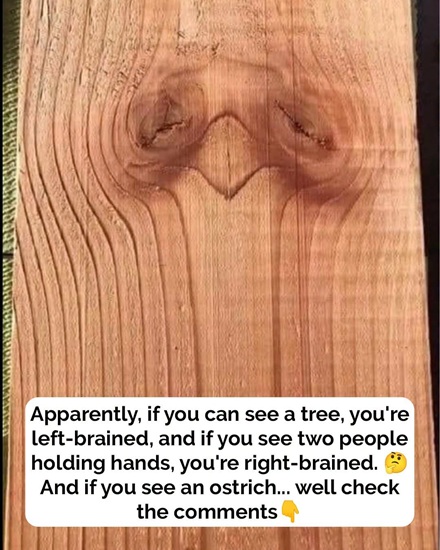
Human perception is one of the most fascinating subjects in psychology and neuroscience. When people look at the same image, they do not always see the same thing first. Some notice shapes, others focus on human figures, and some may even interpret abstract forms differently. This variation is not random—it is influenced by how the brain processes visual information, past experiences, attention, and emotional state. Researchers in cognitive science have long studied how humans interpret visual stimuli.
The brain does not simply “record” what the eyes see like a camera. Instead, it actively organizes, filters, and interprets incoming information. This means that what you notice first in an image can sometimes reflect your attention patterns and cognitive preferences, although it should not be treated as a strict personality test. In online culture, these types of images are often called “optical illusion personality tests.” They are widely shared because they are fun, engaging, and encourage people to think about perception in a different way.
However, psychologists emphasize that such interpretations are not scientifically validated personality assessments. Instead, they are better understood as entertainment tools that highlight how differently people can perceive the same visual information.
How the Human Brain Interprets What It Sees
The human brain receives massive amounts of visual data every second, far more than it can consciously process. To manage this, it uses shortcuts called “perceptual processing.” These shortcuts help the brain quickly identify familiar shapes, faces, objects, and patterns.
This is why some people may immediately notice a human face in an image, while others might first recognize an object like a tree or animal. The brain tends to prioritize what is most recognizable or meaningful based on previous experiences. This process is influenced by attention, memory, and even cultural background.

Scientists explain that perception is not purely objective. Instead, it is shaped by both sensory input and internal mental frameworks. In other words, two people can look at the same picture and genuinely “see” it differently, not because one is right and the other is wrong, but because their brains are interpreting the same data in unique ways.
Why People See Different Things First
When people are asked what they see first in an ambiguous image, their responses can vary widely. Some individuals may focus on larger shapes or dominant patterns, while others are drawn to smaller details. This difference is linked to cognitive style rather than fixed personality categories.
For example, individuals who prefer detail-oriented thinking may notice specific elements first, such as lines, objects, or textures. Others who tend to process information more holistically may immediately recognize the overall scene or emotional meaning of the image.
It is important to understand that these differences do not determine personality in a strict sense. Instead, they reflect how attention is distributed in the brain at a given moment. Factors such as mood, fatigue, and context can also influence what someone notices first.
The Popular “Tree or People” Optical Illusion Explained
One of the most common viral examples of this concept is an image where viewers either see a tree or two people holding hands. Online interpretations often suggest that seeing the tree means someone is analytical, while seeing people first means they are emotional or creative.
However, from a scientific perspective, this is an oversimplification. There is no evidence that identifying one shape over another reveals deep personality traits. Instead, the brain is simply selecting the most visually dominant or familiar pattern first.
If someone notices a tree first, it may be because the structure, contrast, or shape stands out more immediately to their visual system. If another person notices human figures first, it may be due to the brain’s natural tendency to prioritize faces and social forms, a well-known phenomenon called “pareidolia.”
Pareidolia is the psychological tendency to perceive familiar patterns, especially faces, in random or ambiguous stimuli. This is why humans often see shapes in clouds or faces in objects.
Why the Brain Is Wired to Find Meaning
The human brain evolved to quickly detect meaningful patterns in the environment. This ability was essential for survival, helping early humans identify threats, find food, and recognize other humans.
Because of this evolutionary background, the brain is extremely sensitive to patterns, even when they are not intentionally designed. This is why optical illusions and ambiguous images are so powerful—they tap into this natural pattern recognition system.
Modern psychology suggests that perception is a combination of sensory input and predictive processing. The brain constantly makes predictions about what it expects to see and adjusts based on incoming information. This predictive system is highly efficient but not always perfectly accurate.
Entertainment vs Scientific Reality
While viral personality illusions are entertaining and can spark curiosity, they should not be used to define psychological traits or make serious conclusions about personality. Professional psychology relies on validated assessments, structured interviews, and long-term behavioral analysis rather than single-image interpretations.
That being said, these images still have value. They encourage people to reflect on how differently we perceive the world and how subjective perception truly is. They can also serve as a fun way to start conversations about psychology, attention, and human cognition.
What You See Reflects Perception, Not Personality
What you notice first in an image is influenced by many factors including attention, experience, and visual processing—not fixed personality traits. While online tests often present simplified interpretations, the real science of perception is far more complex and fascinating.
Instead of revealing “hidden secrets” about personality, these images highlight something even more interesting: every human brain interprets the world in a slightly different way. This diversity in perception is what makes human cognition so rich and unique.
So next time you look at an optical illusion, enjoy it as a glimpse into how your brain works—not as a definition of who you are.
