Across the internet, millions of people are often drawn to the same intriguing visual puzzles that seem simple at first glance but quickly spark debate and curiosity. These images, often shared on social media platforms, are designed to play with human perception. What makes them so fascinating is not just the image itself, but the way different people interpret it in completely different ways. One person may immediately recognize one shape, while another is convinced they see something entirely different.
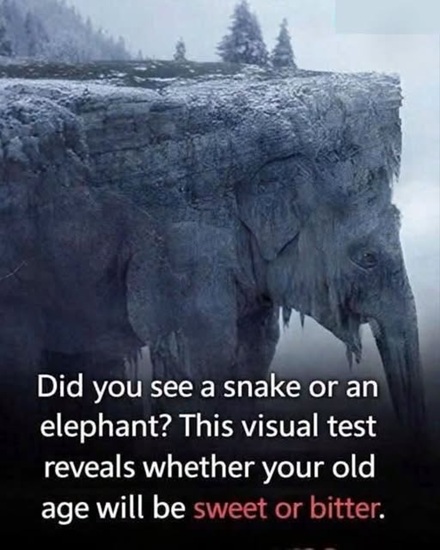
This variation in perception often leads to discussions, comparisons, and curiosity about how the human brain works. One of the most popular types of optical illusions involves hidden figures within natural landscapes or abstract patterns. In these images, viewers are typically asked to identify what they see first, such as animals, faces, or objects hidden within complex visual textures. A well-known example involves a snowy or icy terrain where two different interpretations seem to compete for attention.
Some people report seeing the shape of a snake moving across the frozen surface, while others believe they notice the outline of an elephant formed by rocks and shadows. Both interpretations appear convincing depending on how the viewer’s attention is directed.
What makes these illusions so interesting is that there is no single “correct” way to initially perceive them. The human brain does not process images like a camera. Instead, it actively interprets visual information using patterns, memory, contrast, and expectation. When we look at something complex or ambiguous, our brain quickly tries to match it with familiar shapes stored in memory. This process happens in fractions of a second, long before we consciously analyze what we are seeing.

Optical illusions have been studied for many years in psychology and neuroscience because they reveal how perception works. Researchers have found that vision is not simply about receiving information through the eyes, but about how the brain organizes and constructs meaning from that information. Factors such as lighting, contrast, angle, and even previous experiences can influence what a person notices first in an image. This is why two people can look at the same visual stimulus and come away with different interpretations.
In many viral internet posts, these illusions are often linked to personality traits or behavioral descriptions. For example, some interpretations suggest that people who notice one object first may be more detail-oriented, while those who see another object first may focus more on the bigger picture. However, it is important to understand that there is no scientific evidence supporting the idea that simple optical illusions can accurately determine personality, intelligence, or future behavior. These interpretations are generally created for entertainment purposes rather than psychological diagnosis.
Despite the lack of scientific backing for personality predictions, optical illusions remain popular because they encourage self-reflection and discussion. People enjoy comparing their answers with others and exploring why they might have seen something differently. This sense of curiosity often leads to conversations about how individuals think, observe, and interpret the world around them. In that sense, illusions serve as a fun and engaging way to explore human perception.
When someone sees a snake-like shape first in a complex image, it is usually because their brain quickly identified a long, curved pattern and matched it to a familiar object. This type of rapid pattern recognition is a normal function of human perception. The brain is constantly trying to simplify complex visuals into recognizable forms so that we can process information efficiently. This does not indicate a specific personality type, but rather a natural cognitive process that all humans share.
On the other hand, those who first perceive a larger shape, such as an elephant-like form, may be focusing on broader contours or overall structure rather than small details. This is also a normal and common way the brain processes visual information. Some individuals naturally pay more attention to general shapes before noticing finer details, while others do the opposite. Both approaches are part of normal perception and do not define personality traits in a strict or scientific way.
The human brain uses what psychologists call “top-down” and “bottom-up” processing when interpreting images. Bottom-up processing is driven by visual details such as lines, edges, and contrast. Top-down processing, on the other hand, is influenced by expectations, knowledge, and prior experience. Optical illusions often work by confusing or blending these two systems, causing different viewers to focus on different aspects of the same image.
Another important factor in perception is attention. At any given moment, the brain is exposed to far more visual information than it can consciously process. To manage this overload, it filters and prioritizes certain elements based on relevance or salience. This means that what you notice first in an illusion may depend on where your attention is directed in that specific moment, rather than any fixed characteristic about you.
Mood and mental state can also subtly influence perception. For example, someone who is distracted may miss finer details, while someone who is focused may analyze the image more carefully. However, these effects are temporary and situational. They do not reflect long-term traits or deep psychological differences.
Optical illusions are also widely used in education and research because they demonstrate the limitations and strengths of human perception. They show that what we “see” is not always a direct reflection of reality, but rather a constructed interpretation created by the brain. This understanding has helped scientists develop better models of how vision works and how humans interact with visual environments.
In everyday life, perception plays a much larger role than we often realize. From reading expressions on faces to interpreting road signs or navigating spaces, the brain constantly makes rapid judgments based on incomplete information. Illusions simply highlight this process in a more obvious and noticeable way.
Ultimately, the reason these snake-or-elephant style illusions go viral is not because they reveal hidden truths about personality, but because they tap into something universal: curiosity about how we see the world differently from others. They remind us that perception is subjective and that each person experiences visual reality in a slightly unique way.
Whether someone sees a snake first, an elephant first, or both at different times, the experience is simply a reflection of how the brain organizes visual input. There is no deeper prediction hidden in the image, but there is valuable insight into how human cognition works in general.
In the end, optical illusions are best understood as tools for exploration rather than evaluation. They invite us to question how perception works and to appreciate the complexity of the human mind. While they may not reveal personality secrets, they do reveal something equally interesting: the incredible ability of the brain to construct meaning from ambiguity.
So the next time you encounter an illusion like this, it is worth remembering that what you see first is less about who you are, and more about how your brain processes visual information in that specific moment.
