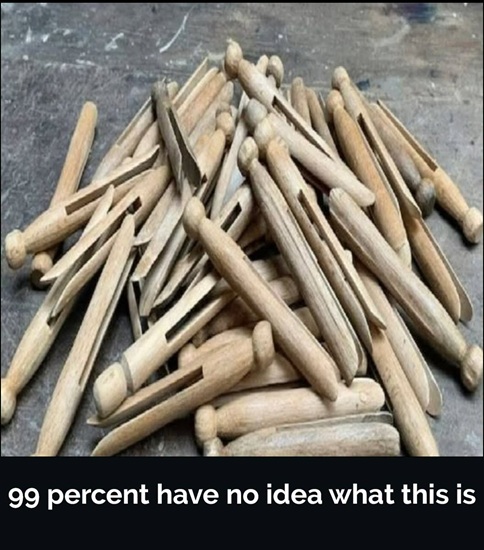
The Forgotten History of the Wooden Clothespin: A Simple Tool That Changed Everyday Life. Long before modern appliances transformed household chores, people relied on simple, practical tools to manage daily life. Among these humble inventions was the wooden clothespin — a small object that played a surprisingly important role in the history of laundry care. It may seem insignificant today, but for generations, it represented efficiency, practicality, and the gradual evolution of domestic work.
In earlier centuries, drying clothes was a slow and often unpredictable process. Without electric dryers, people depended entirely on sunlight, wind, and open air. Clotheslines stretched across yards, between buildings, and over open fields. In these conditions, securing wet garments became a real challenge. Wind could easily blow clothing away, and improvised methods often failed, leading to frustration and loss of valuable clothing items.
Early versions of clothespins were not standardized. In many cultures, people used whatever materials were available — small carved pieces of wood, bone fragments, or even stones shaped to hold fabric in place. These early tools were functional but inconsistent, and they often lacked the durability needed for repeated use. Over time, the need for a more reliable solution became increasingly clear as household laundry demands grew.

By the 19th century, as industrial production began to influence everyday life, inventors started focusing on improving even the simplest household items. One of the most significant developments in this area was the creation of a spring-based wooden clothespin design. This innovation introduced a two-piece structure joined together, allowing the pin to grip fabric more securely and consistently than earlier versions.
A notable improvement came in the mid-1800s, when inventors refined the clothespin into a more practical and efficient tool. One widely referenced design from this period introduced a hinged mechanism that allowed the two wooden arms to apply equal pressure when clamping onto clothing. This reduced the chances of garments slipping off the line, especially during strong winds or changing weather conditions.
The introduction of the spring mechanism marked a turning point in the evolution of the clothespin. Instead of relying on simple friction or weight, the new design used tension to hold items firmly in place. This made the tool far more reliable and significantly improved the laundry drying process for households that depended on outdoor clotheslines.

As industrialization expanded across Europe and North America, the production of clothespins became more standardized. Factories began manufacturing large quantities using consistent designs and materials such as maple and birch wood. This shift made clothespins widely accessible, reducing costs and allowing more households to benefit from improved laundry tools.
During the early 20th century, wooden clothespins became a common household item in many parts of the world. They were simple, inexpensive, and easy to produce, making them ideal for everyday use. Even as new materials and technologies emerged, wooden clothespins remained widely used due to their reliability and environmental advantages.
For many families, hanging laundry on a clothesline was not just a chore but part of daily life. Wooden clothespins became familiar objects associated with routine, community living, and outdoor household work. In some regions, they were even used in schools, crafts, and small-scale production activities, further extending their usefulness beyond laundry care.

Over time, alternative materials such as plastic began to replace wood in many household tools, including clothespins. Plastic versions were lighter and cheaper to mass-produce, leading to their widespread adoption in modern households. However, despite this shift, wooden clothespins never fully disappeared. They continued to be used in areas where durability, tradition, or environmental concerns were prioritized.
Today, wooden clothespins are still found in homes around the world. While their primary function remains the same — holding laundry on a line — they are also widely used in arts, crafts, decoration, and DIY projects. Their simple design and natural material have given them a lasting appeal that goes beyond their original purpose.
In addition to their practical uses, wooden clothespins are often seen as symbols of a slower, more traditional way of life. They represent a time when household tasks required more manual effort and creativity. For some, they evoke nostalgia for earlier generations who relied on simple tools to manage everyday challenges.
The evolution of the clothespin also reflects broader changes in technology and society. What began as a basic handmade object eventually became a mass-produced item shaped by industrial innovation. Yet despite these changes, the core design has remained remarkably consistent, demonstrating the effectiveness of its original concept.
In modern times, discussions about sustainability and eco-friendly living have renewed interest in wooden clothespins. Unlike plastic alternatives, wooden versions are biodegradable and often considered more environmentally responsible. This has contributed to a gradual revival of traditional household tools in certain communities.
Although small in size, the wooden clothespin represents an important part of domestic history. It highlights how simple inventions can have a lasting impact on everyday life. From early handmade versions to modern factory production, its journey reflects human creativity, adaptation, and the ongoing search for practical solutions.
Ultimately, the wooden clothespin remains more than just a laundry tool. It is a reminder of how ordinary objects can carry extraordinary history, connecting past generations with present-day practices in subtle but meaningful ways.
