The Bus Seat Dilemma: What Everyday Choices Might Suggest About Your Personality Have you ever paused to think about how small, everyday decisions might reflect deeper aspects of your personality? Even ordinary moments, such as choosing where to sit or how to behave in a crowded space, can reveal patterns in how we think, prioritize, and respond to others. The “Bus Seat Dilemma” is a simple reflective exercise often used to explore how people interpret empathy, responsibility, and instinct in social situations.
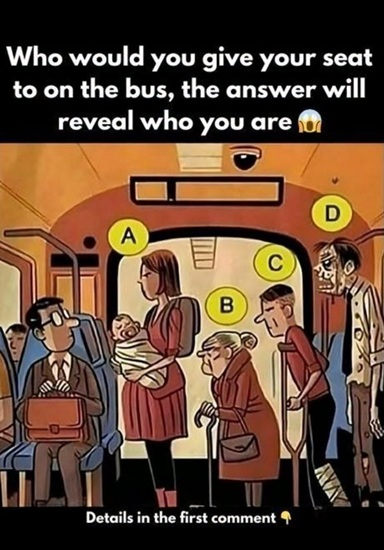
Imagine stepping onto a crowded bus after a long day. People are standing shoulder to shoulder, holding onto rails, and trying to maintain balance as the vehicle moves through traffic. In the middle of this environment, there is only one empty seat left. At the same time, four individuals appear to need it more than others around them.
Each person represents a different type of situation that may trigger different emotional responses. Your instinctive choice in this moment can reflect how you naturally prioritize empathy, fairness, urgency, or social awareness. This is not a scientific test, but rather a thought experiment designed to encourage self-reflection.
The first option is a mother holding her baby. She appears tired, balancing both responsibility and physical strain while caring for an infant. Many people feel an immediate emotional response to this situation because it connects to themes of care, protection, and vulnerability.
If you feel drawn to offering the seat to the mother and child, it may suggest that you naturally lean toward empathy and nurturing behavior. People who identify with this choice often value emotional connection and tend to be sensitive to the needs of others. They may be seen as warm, supportive, and approachable in social environments.
The second option is an elderly woman standing near the aisle. She represents experience, age, and a lifetime of personal history. In many cultures, offering respect and assistance to older individuals is seen as an important social value.
Choosing to give the seat to the elderly woman may reflect a personality that values tradition, respect, and structure. It can suggest that you are thoughtful in your actions and tend to consider social norms when making decisions. People who resonate with this choice often appreciate stability and have a strong sense of courtesy and respect for life experience.
The third option is a man standing on crutches. His physical condition suggests discomfort and limited mobility, making the need for support more immediate in a practical sense. This situation introduces the idea of urgency and physical necessity.
If your instinct is to help the man on crutches, it may indicate that you are responsive to practical needs and tend to act quickly when assistance is required. This choice can reflect adaptability, awareness, and a willingness to step in during moments of urgency. People with this tendency often prefer action over hesitation and trust their instincts in real-time situations.
The fourth option is a visibly sick man who appears unwell and unstable. His condition suggests a different type of urgency, one that may not be immediately physical in movement but still represents clear distress. This scenario introduces a sense of prioritization between visible needs.
Choosing to help the sick man may suggest a personality that is sensitive to distress signals and attentive to health-related or urgent human conditions. It may reflect a sense of responsibility and discernment, where you prioritize situations that appear most critical. People aligned with this choice often think carefully before acting but feel strongly about fairness and well-being.
What makes the Bus Seat Dilemma interesting is not the correctness of any single answer, but the way it highlights different emotional instincts. Each option reflects a different value system, whether it is empathy, respect, urgency, or judgment. These responses are shaped by personal experiences, upbringing, and individual personality traits.
In everyday life, we constantly make similar micro-decisions without realizing it. We decide who to listen to, when to help, and how to respond to people around us. These decisions, although small, contribute to the overall way we are perceived and how we interact with the world.
Psychological reflection exercises like this are not designed to label individuals but to encourage awareness. They help people think about why they react a certain way in social situations and whether those reactions align with their values. Self-awareness often begins with recognizing patterns in these small choices.
It is also important to understand that personality is not fixed based on a single decision. Human behavior is complex and influenced by context, emotions, and environment. The same person may respond differently depending on mood, stress levels, or personal experiences at that moment.
The purpose of the Bus Seat Dilemma is therefore not to define who you are, but to encourage reflection on how you naturally respond to others in moments of limited choice. It invites you to observe your instincts and consider what they might say about your priorities in everyday life.
Ultimately, what this scenario reveals is that kindness and decision-making are not always simple or uniform. They are shaped by a combination of empathy, logic, experience, and personal values. Each person carries a unique balance of these traits, which influences how they act in small but meaningful moments.
In conclusion, the Bus Seat Dilemma serves as a reminder that even the smallest decisions can reflect deeper aspects of who we are. Whether you prioritize compassion, respect, urgency, or fairness, each choice offers insight into your natural tendencies. While not a scientific measurement, it provides a thoughtful way to reflect on how you engage with the world around you.
