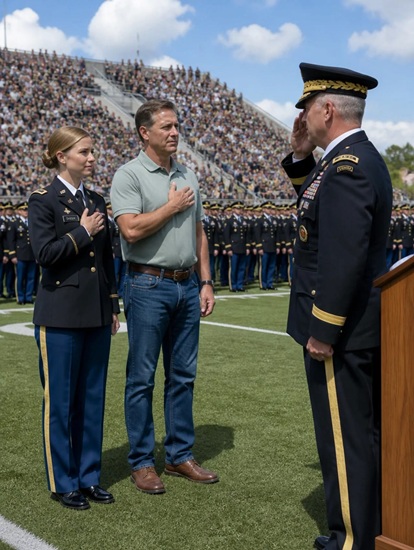
I had spent the better part of the night driving an old freight truck across long stretches of highway, pushing through fatigue and the quiet hum of the road. My destination was Tennessee, where my daughter Emma Carter was about to be commissioned as an Army officer. The journey was not just about distance, but about reaching a moment that represented years of effort, discipline, and quiet pride. By the time I arrived, the morning light had already begun to spread across the grounds of the ceremony.
I stepped out of the truck still wearing the same work clothes I had driven in, aware that I stood out among families dressed in formal suits and dresses. For a brief moment, I felt out of place, but that feeling quickly faded as I reminded myself why I had come. The atmosphere around the ceremony was filled with anticipation and quiet emotion. Families gathered together, speaking in soft tones, taking photographs, and waiting for the event to begin.
There was a shared understanding in the air that this was a significant milestone, not only for the cadets but for everyone who had supported them along the way. When I finally saw Emma, all distance and exhaustion seemed to disappear. She stood in her dress uniform with a calm confidence that reflected both pride and responsibility. When she noticed me, her expression softened into a smile that carried more meaning than words could express. In that moment, the long drive and tired hours felt completely worthwhile.
She walked toward me with steady steps and greeted me warmly, thanking me for making the journey. There was a quiet strength in her voice, the kind that comes from years of preparation and discipline. We stood together briefly, sharing a moment that did not need explanation, only presence.
On my wrist, I wore an old leather band that had been with me for many years. To most people, it would have appeared simple and worn with age. To me, it carried memories of service, responsibility, and individuals I had once stood beside in difficult moments. It was not just an accessory, but a reminder of experiences that shaped who I had become.
As the ceremony began, the hall filled with formal remarks and reflections on service, leadership, and responsibility. Lieutenant General Daniel Mercer addressed the audience, speaking about the weight of duty and the unseen sacrifices made by those in uniform. His words carried through the crowd, setting a respectful and solemn tone for the occasion.
During the event, I noticed that his attention occasionally shifted toward the families gathered in the audience. It was a natural gesture, acknowledging the people who had supported each cadet’s journey. At one point, his gaze briefly seemed to settle in our direction before moving on.
After the ceremony concluded, one of his aides approached and asked if I would be willing to speak with the general. I assumed it was a standard courtesy, perhaps a brief acknowledgment or routine conversation. I did not expect anything beyond that.
When the ceremony ended, Emma and I met briefly among the crowd before being approached by General Mercer himself. He greeted Emma first, offering his congratulations, and then turned his attention toward me. His expression changed slightly as his eyes focused on the worn leather band on my wrist.
He asked me where I had obtained it. The question was simple, but something in his tone suggested recognition rather than curiosity. For a moment, I considered giving a brief or general answer, but instead I chose honesty.
I told him it had belonged to Sergeant Holloway.
At that moment, the general paused. The name clearly carried meaning for him. There was a shift in the conversation, as if a distant memory had been pulled back into focus. What followed was not a formal exchange, but something far more personal and reflective.
He explained that during earlier military operations, there had been moments of confusion and separation among units. Some records were incomplete, and some details had never been fully clarified due to the chaotic nature of those events. Like many situations in active service, not every action had been recorded in a complete or perfect way.
As we spoke further, fragments of past events began to connect through shared recollections. The conversation was not about glorifying the past, but about understanding it more clearly. It was about ensuring that people were remembered accurately, beyond the limitations of incomplete records.
Emma stood quietly beside us during this exchange. She did not interrupt, but she listened carefully. For her, this was not just a military conversation; it was a glimpse into a part of her father’s life that had rarely been discussed in detail.
There were aspects of my service that I had never fully shared with her. Not because I wished to keep secrets, but because some experiences are difficult to translate into everyday conversation. Certain memories remain heavy, not in a way that demands silence, but in a way that makes explanation challenging.
The general spoke respectfully about those who had served alongside us, including individuals whose names were no longer widely known. He emphasized that service is often remembered only by those who lived through it together, rather than by public recognition or official records.
In that moment, the conversation shifted away from rank and position. It became about shared responsibility, memory, and the people who had relied on one another during uncertain times. There was a quiet understanding between everyone present that this was not about individual recognition.
Before the conversation ended, the general retrieved an old photograph from a folder. It was a unit image, slightly worn with age, showing faces of men who had served together. Some had continued their careers, others had moved into different lives, and some were no longer present.
Looking at the photograph, I was reminded that service is rarely defined by recognition. Most experiences remain within the memory of those who were there, carried forward quietly rather than publicly acknowledged. The weight of those moments often stays with individuals long after the events have passed.
The general thanked me for the conversation, and I returned the gesture with appreciation for his willingness to remember details that might otherwise have been forgotten. There was no need for further words at that point. The understanding had already been shared.
As Emma and I walked back toward my truck, she began asking questions she had never asked before. They were not about achievements or formal recognition, but about experiences, emotions, and the human side of service. Her curiosity reflected a deeper understanding forming in real time.
She asked about friendships, challenges, responsibility, and the people whose names had appeared in the photograph. For years, I had kept many of those stories to myself, not out of secrecy, but out of difficulty in finding the right words.
That evening, something changed. I began to share those memories more openly, not because the past had changed, but because the moment felt right for understanding to be passed on. My daughter was now beginning her own path in service, and some lessons are meant to be shared across generations.
The ceremony itself had honored a new officer stepping into a new role. But the conversation that followed reminded me that every uniform carries a deeper history. Behind every new beginning lies a network of past experiences, sacrifices, and relationships that shaped it.
As we left the grounds that day, I understood something more clearly than before. Service is not defined by a single moment or achievement. It is shaped by continuity, memory, and the quiet bonds formed between people who stood together when it mattered most.
