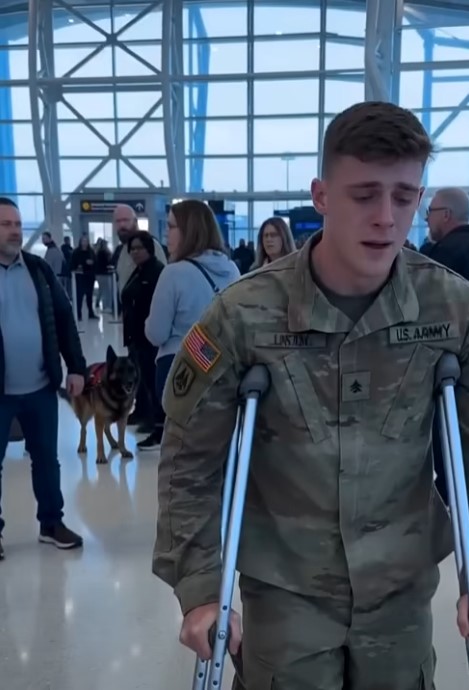
A wounded soldier returned to the United States after months of rehabilitation overseas, expecting a quiet arrival, emotional exhaustion, and an uncertain future waiting for him beyond the airport doors. After nearly a year of medical treatment in Germany, including surgeries and physical therapy, he was finally cleared to travel back home. The journey marked both recovery and emotional transition into a new life. He had spent eleven months learning to walk again using a prosthetic leg after sustaining serious injuries during deployment.
Each step through the airport reflected months of pain, persistence, and slow rehabilitation progress. When he arrived at Gate 12, he moved carefully on aluminum crutches, exhausted from the long international flight and mentally preparing himself for a return that felt both overdue and unfamiliar. There was no welcoming committee waiting for him, no family gathered at the arrivals area, and no messages lighting up his phone. He believed he would return to complete silence and isolation.
The Sound He Never Forgot
As he slowly made his way through the busy terminal, a sudden sound cut through the noise of announcements, rolling suitcases, and distant conversations. It was a bark he recognized immediately. The sound was deep, sharp, and urgent, carrying emotional weight that made nearby travelers instinctively turn their heads. It was not just noise—it was recognition, memory, and connection all at once.
Across the terminal, a German Shepherd in a red service vest suddenly became agitated, pulling strongly against his handler and refusing to obey commands meant to calm him down. The soldier froze in place, his breath catching as he heard the bark again. Something inside him immediately responded, even before his mind could fully process what he was hearing.
The dog turned sharply, locked eyes with him across the crowded airport, and stopped barking instantly, as if time itself had paused between them. The soldier noticed familiar scars along the dog’s muzzle and a slightly torn ear tip, details he had not forgotten even after months of separation.
“Rex?” he whispered, almost in disbelief, as if speaking the name alone could confirm reality rather than memory.
A Reunion in the Middle of the Terminal
The moment the name was spoken, the German Shepherd broke free from his handler and sprinted across the terminal with uncontrollable urgency, ignoring every command shouted behind him. The soldier tried to steady himself, but one crutch slipped as Rex reached him before he could fully regain balance, preventing him from falling completely to the floor.
Rex pressed himself tightly beneath the soldier’s arms, trembling and whining in a way that reflected months of separation, confusion, and emotional waiting finally released in a single moment. The soldier dropped his crutches and wrapped both arms around the dog’s neck, burying his face in thick fur as tears came uncontrollably after months of emotional restraint.
Travelers in the terminal gradually stopped moving. Conversations faded. Security personnel paused. The entire airport seemed to shift its attention toward the emotional reunion unfolding quietly on the floor.
Rex Had Refused to Move On
A volunteer named Clara, who had been overseeing retired military service animals, approached cautiously and later explained what had happened after the soldier was evacuated from active duty. Rex had initially been reassigned to new handlers following standard procedure, but he consistently resisted training adjustments, refusing commands and showing signs of emotional distress and disconnection.
He stopped eating properly, avoided engagement, and repeatedly searched environments as if expecting to find someone he had served alongside, demonstrating unusual behavioral attachment for a trained military working dog. Eventually, Rex was officially retired from active service and transferred through a military K9 retirement and rehabilitation network designed to support working dogs transitioning out of operational duty.
However, even in retirement care, Rex remained unsettled. He showed persistent restlessness, often pacing and reacting strongly to airport-related sounds and environments similar to deployment travel settings. According to Clara, Rex eventually escaped from a monitored facility and made his way to the airport, where he positioned himself near the international arrivals area.
For approximately ninety days, he returned repeatedly to the same location, observing passengers and reacting emotionally each time soldiers or travelers exited international flights.
A New Beginning for Both of Them
The soldier slowly realized that Rex had not been waiting for a past version of him defined by injury or service identity, but rather for his return in any form. Clara gently offered the leash, but the soldier looked down at Rex and hesitated before quietly shaking his head, refusing the symbolic separation that the leash represented in that moment.
“No,” he said softly. “He doesn’t need one anymore. He already knows where he belongs.”
Together, they walked through the airport side by side, the soldier’s crutches tapping steadily against the floor while Rex matched his pace with calm, controlled steps. For the first time since the injury, the rhythm of movement did not feel like limitation. Instead, it felt shared, balanced, and quietly grounding in a way he had not experienced in months.
The Meaning of Home
When they finally arrived at the soldier’s apartment, the space felt unfamiliar, quiet, and emotionally distant, as if time had paused during his absence and left everything unchanged.
Rex entered first, slowly inspecting each room with careful attention, moving from corner to corner before finally settling in the living room as if confirming the environment was safe. The soldier lowered himself carefully beside the dog, sitting on the floor and leaning against him, finally allowing exhaustion, emotion, and relief to surface after months of restraint.
That night, the apartment no longer felt empty or silent. It felt occupied by presence, memory, and connection that did not depend on words or physical perfection to exist.
Rex rested beside him, calm and steady, as if he had never left. And for the soldier, that quiet moment became the first real feeling of home since returning.
