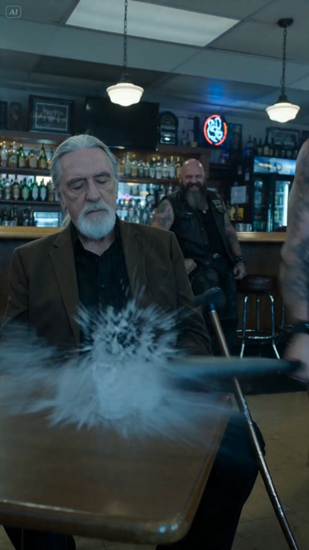
Inside The Copper Rail, the afternoon light filtered weakly through dusty windows, casting long shadows across worn wooden tables where regulars usually gathered for quiet meals, conversations, and brief moments of escape from daily life. Walter Kane had been sitting alone for nearly twenty minutes, positioned deliberately at the table closest to the wall, as if he preferred distance from attention rather than being part of the noise around him. At seventy-two, Walter carried himself with quiet discipline.
His silver hair was neatly tied back, his white beard trimmed, and a simple brown suit rested on his frame like something chosen with intention rather than fashion. Beside his chair rested a wooden cane, worn smooth from years of use. In front of him sat a glass of water, untouched, reflecting the dim bar lights like a surface waiting for something to happen. The bartender, Nora, moved behind the counter with careful routine, but her eyes kept drifting toward Walter.
She was not afraid of him, but she understood why his presence carried a different kind of weight that day. For months, the bar had been under pressure from a biker group led by a man named Rex Dalton. They arrived loudly, occupied space aggressively, and created an atmosphere of intimidation disguised as control and protection.
What they called protection was, in truth, coercion. Customers felt uneasy, staff felt monitored, and the once welcoming environment of The Copper Rail had slowly shifted into something quieter and more guarded than before. Nora’s husband had suggested involving law enforcement earlier, but she hesitated, believing the situation involved deeper connections that might escalate danger rather than resolve it, especially given Rex Dalton’s reputation in the area.
Instead, Nora had reached for a number she had kept hidden for years, written on an old business card left behind by her late father, a number she had never expected to use until that moment. That call eventually brought Walter Kane into the situation. He arrived without announcement, without force, and without drawing attention, yet his presence immediately suggested experience, authority, and a history that was not easily explained.
At precisely 12:17, the front door of The Copper Rail opened. The sound of it interrupted conversations, drawing attention from nearly everyone inside, though most quickly looked away when they recognized who had entered. Rex Dalton stepped inside first, followed by five men. He wore a black leather jacket decorated with patches, and a heavy baton hung loosely from one hand, used more for intimidation than necessity.
The group moved with confidence that depended heavily on the discomfort of others. Their laughter filled the room briefly, but it faded quickly as they scanned the space and noticed Walter sitting alone at the table. Rex’s attention locked onto him almost immediately. He walked forward slowly, deliberately, as if the entire room existed only to witness his approach, while his men stayed behind, watching in silence.
Walter did not move when Rex arrived. He simply observed him calmly, his expression unchanged, his posture steady, as though he had already anticipated this moment long before it actually occurred inside the bar. Rex spoke first, mocking Walter’s age and presence, implying he did not belong in a place controlled by younger, stronger men. His tone carried confidence, but also a need for dominance over uncertainty.
Walter responded calmly, without raising his voice or showing visible emotion. That lack of reaction seemed to irritate Rex more than any insult could have, because it offered no resistance to provoke or control. Rex stepped closer, tapping the baton against the table once, then striking it harder. The glass in front of Walter shattered instantly, water spilling across the table and fragments scattering onto the floor below.
The sudden noise silenced the room. Conversations stopped. Nora froze behind the counter. The biker crew laughed briefly, but their laughter felt forced, filling space that had already shifted into tension and discomfort. Walter slowly looked at the broken glass, then at his wet sleeve, and finally at his cane lying on the floor. He did not react with anger, only with measured observation and controlled stillness.
Instead of responding immediately, he reached into his jacket and removed a phone. The action was calm, deliberate, and unhurried, drawing Rex’s attention as he assumed it was a call for help. Walter lifted the phone to his ear and spoke only two words before pausing briefly, then adding a short instruction. His voice remained steady, carrying neither fear nor urgency, only certainty in what followed next.
“It’s me,” he said first. Then after a pause, “Bring them.” He ended the call without explanation, placing the phone back into his jacket while the room remained completely silent and unsettled. Rex laughed briefly, attempting to regain control of the atmosphere, but the sound outside changed everything. Tires approached, followed by multiple vehicles pulling into the gravel lot just outside The Copper Rail.
Black SUVs arrived first. Men in dark suits stepped out quickly, scanning the area. A woman in a navy coat followed, accompanied by uniformed officers and older men wearing faded jackets with silver hawk insignias. The room inside shifted instantly. Rex’s confidence weakened as unfamiliar authority filled the space. One suited man entered and confirmed that exits were secured, while the woman introduced herself as Assistant District Attorney Rebecca Miles.
The officers positioned themselves carefully, while the older men remained near the entrance, watching quietly. Their presence carried familiarity with Rex’s group, and their expressions suggested history rather than surprise or confusion. Walter then addressed Rex directly, asking if he understood the meaning of the silver hawk symbol on their jackets. Rex assumed it represented dominance, but Walter corrected him with calm authority.
He explained that the original Silver Hawks were not a gang of intimidation, but a group of veterans, workers, and citizens who protected vulnerable people, escorted witnesses, and supported communities facing fear or injustice. Rex had distorted that legacy, using its reputation to intimidate others rather than uphold its original purpose. Walter’s tone remained steady as he revealed that Rex’s understanding of his own identity was incomplete.
Then Walter said something that shifted the entire atmosphere inside the room. He revealed that Rex’s mother, Elena Dalton, had been his daughter, and that their histories were far more connected than Rex realized. Rex froze at the mention of her name. Walter described details of Elena’s life, her connection to the Silver Hawks, and her efforts to distance herself from the violence surrounding Rex’s father and associates.
He also revealed that the cane Rex had knocked to the floor belonged to Thomas Dalton, Rex’s grandfather, a man once respected for protecting others rather than threatening them, unlike how Rex had been behaving. The older riders confirmed this silently, and one of them stated that Thomas would have been ashamed of Rex’s actions. The statement carried more weight than anger, rooted in disappointment rather than confrontation.
Assistant District Attorney Miles then explained that Rex’s organization had been under investigation for months, involving allegations of extortion, intimidation, illegal business pressure, and financial laundering across multiple locations and communities. Walter clarified that The Copper Rail was not an accidental meeting place, but part of a controlled investigation, and that he served as trustee of the property, ensuring evidence could be gathered legally and safely.
He then revealed Elena’s hidden past, explaining she had once tried to expose criminal activity tied to Rex’s father. She had planned to testify but died before she could complete her statement. Rex initially resisted the truth, but his certainty began to fracture when Walter presented a photograph of Elena holding him as a baby, reminding him of a relationship he could no longer deny or rewrite.
The tension escalated briefly when Rex lifted his baton again, but officers reacted immediately. Walter raised a hand, stopping intervention, and told Rex directly to put it down and decide what kind of man he would be. After a long pause, Rex dropped the baton. The sound echoed across the floor, marking a turning point. Officers moved in, detaining members of his group while Rex remained still, watching Walter in silence.
The legal case expanded beyond the bar, uncovering multiple victims across different communities. Small business owners, elderly residents, and vulnerable individuals came forward with testimonies previously suppressed by fear or lack of support. Rex ultimately faced charges related to extortion, intimidation, and organized criminal activity. However, what impacted him most was not the legal consequences, but the emotional weight of learning the truth about his mother.
At sentencing, Walter did not seek revenge. Instead, he emphasized responsibility, explaining that harm cannot be erased by understanding alone, and that justice must balance accountability with truth and acknowledgment of suffering. Rex was sentenced to prison, restitution, and cooperation with ongoing investigations. Over time, his organization collapsed, and the influence of the Dalton Kings faded from the communities they once controlled through fear.
The Silver Hawks later reformed in a different capacity, focusing on community support, assisting vulnerable individuals, and restoring trust in places where intimidation had previously replaced safety and stability. The Copper Rail reopened fully. Nora preserved a small piece of the broken glass in a frame behind the bar, labeling it with a simple message about courage overcoming fear in quiet but meaningful ways.
Years later, Rex returned alone, changed and quieter, seeking apology rather than control. He spoke first to Nora, acknowledging harm, then to Walter, accepting responsibility without expecting immediate forgiveness or acceptance. Walter allowed him to sit, but set clear boundaries. Rex agreed to accountability, continued restitution, and removal of his past associations. The interaction remained cautious but no longer defined by fear or dominance.
The bar gradually returned to normal life. Conversations resumed, customers returned, and The Copper Rail became once again a place defined by routine, memory, and the absence of intimidation that once filled its space. What remained was not just a story of confrontation, but a reminder that power does not always come from force. Sometimes it comes from truth, patience, and the ability to change the direction of a room without violence.
