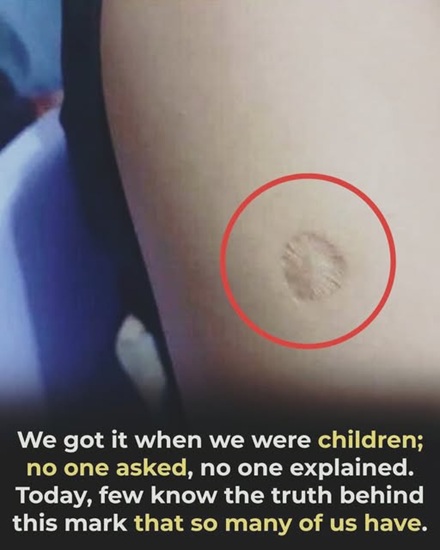
I never paid much attention to it as a child, though it was always there—a small, circular scar on my mother’s upper arm, faint and easy to overlook amidst the busyness of everyday life and childhood routines. It was one of those marks that blends into the background, familiar yet unremarkable. Over the years, I rarely thought about it, and when I did, it was more curiosity than concern driving my attention. Years later, I encountered a strikingly similar mark on a stranger.
While helping an elderly woman step off a crowded train, her sleeve shifted, revealing a small round scar in the exact same location. It was uncanny, unmistakable. The scar was identical in shape and size, and my mind immediately connected it to my mother. The coincidence prompted questions I had never asked and reflections I hadn’t considered.
Later that day, I called my mother, finally gathering the courage to ask about the tiny, almost forgotten mark I had noticed so long ago. Her response was simple yet profound. “It’s from the smallpox vaccine,” she said calmly, as if it were an ordinary piece of history rather than a deeply significant human achievement. That short answer opened a doorway to a larger story.
For millions of adults born before the early 1970s in the United States, and similar generations worldwide, this small round scar represents a shared history, a silent testament to one of public health’s greatest triumphs. Some of these scars are barely visible, almost ghostly reminders of the past. Others remain remarkably distinct, marking the skin decades later with a precise, circular outline that hints at a life-saving intervention.
What makes this scar remarkable isn’t its size, but the story it tells—a story of a disease that once terrified families, destroyed communities, and left indelible marks on human history across continents. Smallpox was not merely an inconvenience or a mild illness; it was a devastating infectious disease that carried high mortality rates and permanent scarring for those who survived its infection.
The disease often began insidiously, with fever, body aches, weakness, and exhaustion. Soon after, the telltale rash appeared, progressing to painful pustules and scabs that covered the body, sometimes leaving lifelong marks. Entire communities lived in fear of outbreaks. In towns, cities, and villages, the appearance of smallpox could mean quarantine, death, and the loss of multiple family members within weeks of infection.
Before vaccination programs, smallpox was an omnipresent threat. It shaped human behavior, forced public health interventions, and created a climate of constant vigilance against an invisible, lethal adversary. The smallpox vaccine introduced a radical shift in humanity’s ability to fight disease. Unlike modern injections, it used a unique method designed to produce a visible reaction on the skin. A two-pronged needle was employed to prick the upper arm repeatedly in a small area, introducing the live vaccinia virus that would trigger immunity against the deadly smallpox virus.
This process intentionally created a bump, then a blister, followed by a scab. Once the scab healed, it often left a small, circular scar, identical in most individuals, marking both immunity and survival. This is why generations of adults carry the same kind of scar in almost the exact spot, a uniform, quiet symbol of shared resilience and scientific triumph against a global disease.
While the scar may seem minor, it represents a deeper victory. It is an emblem of human ingenuity, of medical progress, and of collective action across nations to protect the vulnerable. Smallpox vaccination campaigns were massive, coordinated efforts spanning decades. Healthcare workers traveled to remote villages, often at great personal risk, to administer vaccines and contain outbreaks before they could spread.
The success of these programs culminated in 1980 when the World Health Organization officially declared smallpox eradicated. It became the first human disease eliminated worldwide through coordinated global public health initiatives. This victory stands as one of the most significant accomplishments in modern medicine. It demonstrated the power of vaccines, international cooperation, and sustained public health effort to protect future generations.
The small circular scar, innocuous as it may appear, silently connects its bearer to this remarkable history, carrying a story of survival, resilience, and human determination to defeat a deadly virus. For those of us who encounter such a mark—on a parent, relative, or stranger—it becomes a moment to pause and reflect on the enormous challenges humanity has overcome through science and compassion.
Smallpox shaped not only health outcomes but also culture and daily life. Parents lived in fear of children contracting the virus, towns enforced quarantines, and entire economies were disrupted by outbreaks. Vaccination was more than medicine; it was a promise of protection, a commitment to future safety, and a demonstration of the value of scientific intervention against naturally occurring disease threats.
In the United States, the vaccine was commonly administered to children, often leaving the familiar circular mark on the upper arm. Parents understood its importance even as the procedure left a visible reminder. The scar, therefore, is not merely a medical artifact. It is a symbol of trust in science, the dedication of healthcare professionals, and the enduring impact of preventive medicine on human life.
Many adults carry this mark unknowingly as a daily emblem of resilience. It is a subtle, silent reminder of an era when smallpox shaped the contours of society and demanded coordinated human action. Seeing the scar again on someone else—a stranger, no less—reinforces the universality of the experience. It bridges time and geography, linking generations who have faced the same invisible threat.
It also serves as a reminder that history often resides in the body. Lessons, victories, and challenges are etched into our lives in subtle, often overlooked ways, waiting to be rediscovered. The smallpox scar reminds us of the fragility of life, the bravery of healthcare workers, and the immense power of global collaboration in the face of shared human threats.
It is a testament to what humans can achieve when working together, transcending borders, and prioritizing collective well-being over individual inconvenience or fear. For younger generations, the scar may seem ordinary, irrelevant, or even mysterious. But for those who remember the fear of smallpox, it carries immense historical weight and emotional resonance. The presence of the scar reminds us that science, perseverance, and human cooperation can eradicate even the deadliest diseases, leaving behind only small, circular proof of triumph.
It also highlights the personal dimension of history. Each scar represents an individual story, a person vaccinated, a family protected, and a future safeguarded against a once-terrifying virus. The scar connects past to present, reminding us of resilience, public health, and the power of preventative medicine in safeguarding human life across generations and continents.
Though small and easily overlooked, the scar on the upper arm carries a vast narrative: fear, suffering, scientific achievement, and ultimately, a triumph of human ingenuity over one of history’s deadliest diseases. When we notice it again—in ourselves, family members, or strangers—we are invited to reflect on humanity’s collective ability to overcome crisis, preserve life, and leave a legacy of protection for the future.
It is a reminder that history is often invisible, present in quiet details, and that the smallest marks can carry the weight of extraordinary human achievement and resilience. Sometimes, history does not reside in textbooks or monuments. It lives quietly in the human body, in the scars that bear witness to a shared, remarkable journey of survival and scientific progress.
The scar is more than skin deep. It carries lessons of public health, scientific foresight, human courage, and the value of working together to protect life against deadly threats. If you—or someone in your family—have this small circular mark on the upper arm, it is worth pausing to consider the extraordinary history it represents, a symbol of human resilience, medicine, and hope. Even the smallest, seemingly insignificant details—like a scar—can link us to profound stories, reminding us of the victories, struggles, and perseverance that shape human history in ways we often overlook.
Next time you notice that familiar, small round scar, consider it a quiet, enduring emblem of history: a mark left not by pain alone, but by human ingenuity, care, and collective survival. It is a reminder that one simple mark can connect generations, tell stories of courage and innovation, and serve as a lasting testament to the triumph of science over a once-feared disease. Sometimes, the quietest marks carry the biggest stories. That small circle on the upper arm is a shared human legacy, linking all who bear it to one of history’s most remarkable public health victories.
