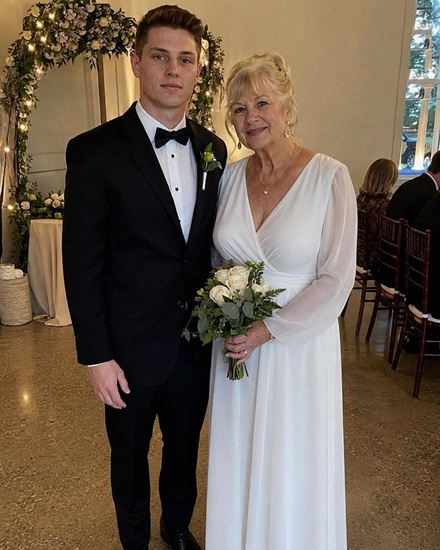
I married Evie because I needed survival more than I needed honesty, and at the time I convinced myself those two things could exist together without consequences following me later in life. She was seventy-one, a widow living alone in a quiet house that always smelled like lavender and old books, while I was twenty-five and barely holding my life together financially or emotionally. I had no stable home, no real savings, and no direction beyond the next meal, so when Evie offered stability through marriage, I accepted what felt like my only escape from collapse.
I told myself it was gratitude rather than manipulation, but deep down I knew I was trading emotional truth for physical security, even if I refused to fully acknowledge it at the time. Her house became my refuge almost immediately, with warm lights, stocked cupboards, and silence that felt safer than the noise of debt collectors and broken promises outside those walls.
Evie never treated me like a burden, even though I suspected she understood more about my situation than I was willing to admit aloud during our early conversations together. When I told my friend Jesse about the marriage, he laughed in disbelief, suggesting I had found shelter disguised as commitment, but I defended it as something more legitimate than that. Still, I could not ignore the fact that I had entered the relationship carrying desperation instead of love, and that truth lingered quietly behind every conversation I had with her.
Before the wedding, Evie placed a prenuptial agreement on the table without hesitation, outlining ownership boundaries clearly, reminding me that loneliness does not mean loss of judgment or financial awareness. I signed it without argument, telling myself I did not care about assets, though the reality was that I cared more than I wanted to admit in private reflection. Life inside her home was structured and calm, filled with small routines, medical appointments, and careful habits that reminded me she was aging while I was still trying to start life.
I noticed every pill bottle, every calendar note, every hospital visit, quietly measuring time in a way I never allowed myself to measure my own uncertain future. Despite everything, Evie treated me with unexpected kindness, leaving clothes for me when I had none, and quietly adjusting her life so I could exist more comfortably in her space. At times I rejected her help out of pride, but she never argued, simply observing me with calm understanding that made me question whether she truly believed I was staying for the right reasons.
In public, people admired her easily, and I often felt like an outsider standing beside her warmth, aware that strangers saw her value more clearly than I understood my own actions. That contrast made me uncomfortable, and I began withdrawing emotionally, even while relying on her presence for stability, creating a contradiction I could not resolve through simple rationalization. One night, she collapsed briefly on the stairs, and although she insisted she was fine, I saw something fragile in her that I tried unsuccessfully to ignore afterward.
I made tea for her in silence, and for a brief moment the house felt like something close to peace rather than an arrangement built on necessity and hidden motives. My phone buzzed with a message from Jesse during that moment, reminding me of the outside world and the life I had paused rather than truly changed. The message was careless, joking about my situation, but it reinforced how far I had drifted from honesty, even with myself, while sitting inside Evie’s quiet kitchen.
Days later, Evie suddenly collapsed in the kitchen, and despite my attempts to help, she passed away shortly after at the hospital from a heart-related condition.
Her death left the house empty in a way that felt immediate and irreversible, transforming every room into a reminder of silence I had not prepared myself to face. At the funeral, her niece looked at me with suspicion rather than sympathy, as if she already understood the imbalance of intention that had existed in my marriage to Evie. The reading of the will confirmed that the house and savings were directed elsewhere, leaving me with nothing material except a single personal item from Evie’s final instructions.
Her lawyer handed me a small shoebox, carefully labeled with my name in her handwriting, and I opened it expecting confusion, curiosity, or at least something symbolic. Inside, I found printed messages I had once sent in private, including careless words about being “set once she was gone,” preserved with unsettling accuracy and intent. Each item in the box carried annotations in Evie’s handwriting, reflecting her quiet observation of my behavior over time, including moments of kindness mixed with clear emotional distance.
There were receipts for clothing she had bought for me, medical payments she covered, and notes describing my reactions in ways that felt both personal and painfully precise. Her letter explained that she had known my intentions long before I admitted them to myself, but she chose not to expose me immediately or remove me from her life. Instead, she observed, documenting not only my flaws but also moments where I acted with unexpected decency, even when my overall motivations remained deeply conflicted and uncertain.
She wrote that she did not marry me only out of pity, but also out of her own loneliness, recognizing that both of us had entered the relationship from different forms of need. The choice she left me was simple but heavy: disappear quietly with the truth hidden, or confront the people who knew her and acknowledge everything I had tried to conceal. At a community gathering held in her memory, I stood in front of strangers and admitted the truth about why I had married her and how I had viewed her situation at the time.
The words were difficult to speak, but silence felt heavier, and I understood that honesty, even delayed, was the only form of respect I could still offer her memory. In the months that followed, I began slowly repaying what I could, not because I was required to, but because I understood that avoidance no longer had any place in my life. Working small jobs and volunteering at community centers, I tried to rebuild something that resembled integrity, even if it could never erase the choices I had already made.
Eventually, I visited her grave and left the final remnants of her shoebox message behind, choosing not to carry it as shame, but as a reminder of what I had become. I did not leave the past behind fully, but I stopped allowing it to define every step forward, understanding that change requires action rather than regret alone. In the end, Evie did not give me wealth or escape; she gave me the uncomfortable truth about myself, and forced me to live differently after she was gone.
