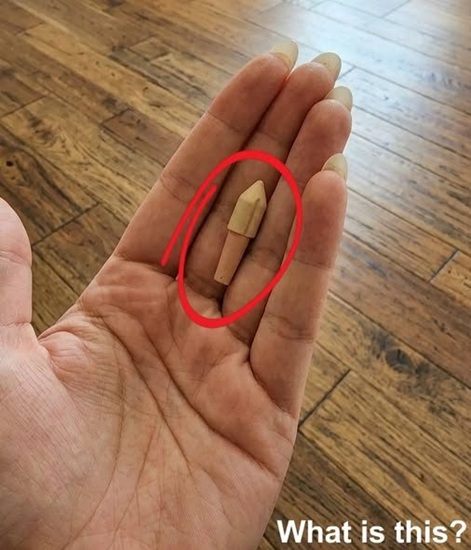
The moment my fingers brushed against the cold, jagged piece of metal hidden deep inside the lining of my husband’s jeans, I felt my entire body react before my mind could even catch up. It was heavy, deliberate, and unsettling in its shape, like something that belonged to a very specific purpose rather than an ordinary pocket. I stood frozen in the laundry room, staring at the object in my palm while my thoughts spiraled into immediate suspicion.
In that split second, my imagination leapt far ahead of reason, building scenarios I had no evidence for but couldn’t seem to stop. I turned it slowly under the dim overhead light, trying to understand what I was looking at. The surface was smooth but slightly worn, with faint scratches near one end that suggested use. The shape was unusual enough to feel unfamiliar, almost engineered rather than casually made or forgotten. My chest tightened as I tried to match it to anything I knew from everyday life, but nothing fit cleanly into place.
That uncertainty made my thoughts louder, more dramatic, and far less rational than I wanted them to be. When I finally confronted my husband, I expected hesitation, confusion, or at least concern that I had found something strange in his belongings. Instead, he barely looked up. His reaction was calm to the point of frustration, as if I had brought him something completely insignificant.

He shrugged and said he didn’t know what it was or how it ended up in his pocket. That calmness, rather than reassuring me, only deepened my unease, because it felt disconnected from the urgency building inside me.
For nearly an hour afterward, I stayed in the laundry room, sitting on the edge of the basket while I kept turning the object over and over in my hands. The house was quiet in a way that felt heavier than usual, as if the silence itself was pressing against me. I tried to focus on logic instead of emotion, but every angle I examined seemed to raise more questions than answers. The longer I looked at it, the more my mind filled in gaps that might not even exist.
I began imagining possibilities I normally would never consider. I thought about secrecy, about hidden habits, about parts of a person’s life that exist outside of shared knowledge. The object felt like a clue in a story I hadn’t been told yet, and I hated how quickly my thoughts drifted toward suspicion. I replayed recent moments in my mind, searching for signs I might have missed, trying to connect something ordinary to something alarming.
At one point, I even convinced myself I might be dealing with something dangerous or intentional, something deliberately concealed. The shape seemed too precise for randomness, too structured for coincidence. I felt like I was holding evidence of something significant, even though I couldn’t define what that “something” was. My imagination filled the gaps faster than reality could correct them, and I didn’t realize how far I had gone until I noticed my own breathing had changed.
Eventually, I forced myself to slow down and look at the object more carefully, this time paying attention instead of reacting. I moved closer to the window where the light was stronger and rotated it slowly between my fingers. That’s when I noticed something I had completely overlooked before: faint markings etched near the base. They were subtle, almost invisible unless the light hit them at the right angle, but they immediately shifted the entire meaning of what I was holding.
I focused on those markings, tracing them with my thumb until recognition finally replaced confusion. The shape, the weight, the design—all of it suddenly made sense in a completely different context. The tension I had been carrying in my chest began to collapse inward, replaced by a wave of embarrassment I wasn’t prepared for. What I had assumed was suspicious or even threatening turned out to be something far more ordinary than my fear had allowed me to see.
It was not a weapon, not a hidden device, and not evidence of anything secret or dangerous. It was a field point used for archery practice, designed specifically for target training. Something meant for precision and sport, not secrecy or harm. The realization landed heavily, not because of what the object was, but because of what I had convinced myself it might be in the absence of understanding.
When I finally sat back, still holding it in my hand, everything about the moment shifted. The object no longer felt heavy or threatening; it felt small, almost harmless. The fear that had built up so quickly now seemed fragile in hindsight, built entirely from assumption rather than fact. I thought about how easily my mind had filled silence with stories that were never real.
Later, I understood that my husband hadn’t been hiding anything at all. He had simply not mentioned a quiet hobby he had picked up—something personal and simple that he hadn’t thought to explain. There was no secret life, no hidden danger, only a private interest that had accidentally ended up in a place I wasn’t expecting.
What stayed with me most wasn’t the object itself, but how quickly trust can be shaken by uncertainty. I realized how easily the mind can turn unfamiliar details into fears when there is no explanation to ground them. In the end, the real lesson wasn’t about what I found in his pocket, but about how fragile assumptions can be when they replace communication and understanding.
