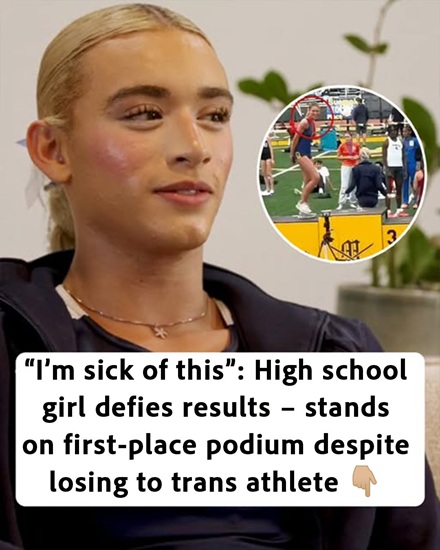
A recent California high school track and field competition has drawn widespread attention online after a podium moment involving athletes in the girls’ triple jump event went viral across social media platforms. The incident occurred during the CIF Southern Section Finals, one of the most competitive high school athletics events in California, where student-athletes compete for qualification to higher-level championships.
At the center of the discussion is a moment involving Crean Lutheran High School athlete Reese Hogan and Jurupa Valley High School athlete AB Hernandez, whose performance and identity have become part of a broader national conversation on sports policy. During the girls’ triple jump final, athletes competed for top positions based on distance achieved across a series of attempts. AB Hernandez recorded the longest jump in the event, securing first place according to official results.
Reese Hogan finished second in the same competition, delivering a strong performance that placed her among the top athletes in the event. Both athletes qualified through a competitive field of high school participants. Following the conclusion of the event, the official awards ceremony was held, where medals and placements were presented to top performers according to the final rankings established by the meet officials.
Viral Podium Moment and Social Media Reaction
After the ceremony, a separate moment captured attention online when Reese Hogan briefly stepped onto the top podium position during a post-event scene. This moment was recorded and shared widely on social media platforms.

The clip quickly circulated across multiple online communities, generating discussion and debate regarding interpretation of the gesture and its meaning within the context of competitive sports.
Some viewers interpreted the moment as symbolic protest, while others viewed it as an emotional reaction to competition results. However, no official statement confirmed any intended protest by the athlete or school representatives.
As with many viral sports moments, the short clip spread rapidly without full context of timing, intent, or post-event conditions surrounding the athletes involved.
Background on Transgender Athlete Participation in School Sports
The participation of transgender athletes in school sports has become a subject of policy discussion across the United States. Rules governing eligibility vary by state and athletic association, including guidelines set by organizations such as CIF.
In California, current policies allow student-athletes to compete in accordance with gender identity guidelines established by governing sports bodies. These policies are part of broader inclusion frameworks adopted in several states.
Supporters of inclusion policies argue that student-athletes should be allowed to participate in sports consistent with their gender identity, emphasizing access, equality, and mental health considerations.
Opponents of current policies raise concerns about competitive fairness and physical differences in athletic performance, particularly in strength and speed-based events such as track and field.

Official Event Structure and Qualification
The CIF Southern Section Finals represent a high-level regional competition that determines qualification for subsequent championship stages, including the CIF Masters Meet.
Athletes who place at the top of their events advance based on recorded performance metrics such as distance, time, or score depending on the discipline.
In the girls’ triple jump event, performance is measured by the longest legal jump distance achieved during competition attempts, under standardized rules followed nationwide in track and field events.
Broader National Debate on Policy Direction
The incident has been referenced in broader discussions about sports policy in the United States, where state governments and athletic organizations have taken differing positions on transgender participation rules.
Some states have introduced legislation restricting participation in women’s categories, while others maintain inclusive eligibility rules under current school sports frameworks.
At the federal level, sports policy continues to be debated, with proposals and executive actions periodically emerging regarding eligibility standards in competitive athletics.
These policy differences have created a fragmented regulatory environment across the country, where rules vary depending on jurisdiction and governing body.
Perspectives From Supporters of Inclusion
Advocates for inclusion policies emphasize that high school sports should prioritize participation, fairness in opportunity, and protection of student rights under educational and civil frameworks.
They argue that student-athletes should not be excluded from competition based solely on gender identity and that sports governance should reflect broader inclusivity standards in education.
Supporters also highlight that athletic performance varies widely among all competitors, and that outcomes in sports are influenced by training, coaching, and individual development.
Perspectives From Critics of Current Policies
Critics of current inclusion frameworks argue that physical differences may impact competitive balance in certain categories of sport, particularly in strength and performance-based events.
They advocate for policy revisions that they believe would ensure equal competitive conditions in girls’ and women’s divisions while maintaining separate pathways for different eligibility categories.
This perspective has contributed to ongoing legal, political, and institutional debates across school districts, state legislatures, and athletic organizations.
Public Response and Online Discussion
Following the viral spread of the track meet clip, social media platforms saw widespread commentary from users expressing a range of opinions on the issue.
Some users focused on fairness in competition, while others emphasized respect for inclusion policies and the importance of following established sports regulations.
As with many viral sports-related topics, online discussion often intensified beyond the original context of the event itself, reflecting broader national divisions on the issue.
Athlete Participation and Performance Context
AB Hernandez, who competed in the event, recorded top results in multiple disciplines during the meet, qualifying for additional championship-level competitions based on performance standards.
Other athletes, including Reese Hogan, also delivered competitive performances that placed them among regional finalists in their respective events.
High school track and field competitions typically involve multiple rounds of qualification, with athletes advancing based on measurable performance outcomes rather than single-event narratives.
Ongoing Policy Discussion in School Athletics
School athletic associations continue to review and update policies related to eligibility, inclusion, and competitive structure as public discussion around the issue evolves.
These policies are often influenced by legal frameworks, medical guidelines, educational standards, and stakeholder input from schools, parents, and governing boards.
Because of this complexity, rules differ significantly between states and organizations, leading to continued debate about standardization in national school sports.
Conclusion
The California track meet incident has become part of a larger national conversation about fairness, inclusion, and policy in school athletics.
While the specific event involved individual athletes competing under established rules, its viral spread has amplified broader questions already being discussed across the United States.
As policy discussions continue at state and national levels, school sports organizations remain at the center of balancing inclusion, competition structure, and student participation rights.
The debate is expected to continue as more events, legal decisions, and policy updates shape the future of high school and collegiate athletics in the country.
