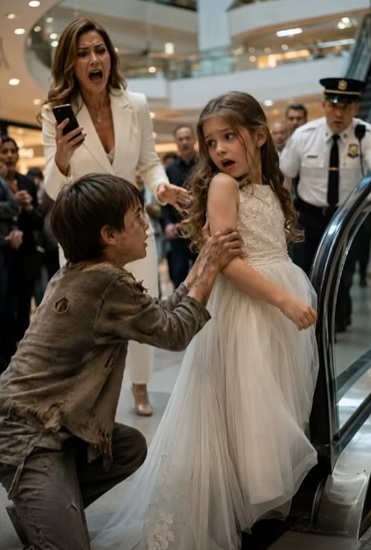
The entire mall had been filled with the usual quiet rhythm of an ordinary afternoon. People walked through polished hallways carrying shopping bags, children ran slightly ahead of their parents, and soft music played from hidden speakers above. It was the kind of atmosphere where nothing unusual seemed possible, where every moment blended into the next without interruption. That sense of normality broke in an instant. Near the escalator area, a sudden scream cut through the background noise.
A small child in a white dress had become entangled in the moving mechanism. The fabric, light and flowing only seconds before, was now caught and being pulled downward by the machine’s steady motion. The escalator continued moving as if nothing had changed, unaware of the danger unfolding on its steps. People turned quickly, confused at first, then alarmed. The child was pulled free in the chaos, but the dress remained trapped in the escalator’s mechanism.
The movement of the machinery twisted the fabric tightly between the metal steps, creating a distressing visual that immediately drew attention from everyone nearby. Panic spread as voices rose, calling for the escalator to be shut down. A young boy stood only a few steps away from the scene, breathing heavily, his hand still extended forward. It looked as though he had just pulled the child away at the last possible moment. His posture suggested urgency, not aggression, but in the confusion of the moment, not everyone interpreted his actions correctly.
The mother of the girl reacted instantly and instinctively.
She saw only what appeared to be a stranger grabbing her child without warning. Her fear overwhelmed her judgment. She shouted for security and moved between the boy and her daughter, believing she was protecting her child from danger. In her eyes, the situation was unclear, and the boy’s sudden movement looked threatening.
But within seconds, the reality of the situation became painfully obvious.
The escalator had already taken the girl’s dress, and had the boy not intervened, she might have been pulled further into the mechanism. The severity of the danger became clear as staff rushed to hit the emergency stop button, bringing the escalator to a sudden halt. The mechanical sound faded into silence, replaced by gasps and shaken breathing from those nearby.
The atmosphere changed completely.
What had moments ago been confusion turned into shock and realization. The mother dropped to her knees, pulling her daughter into her arms. The child was crying, shaken but physically safe. However, her attention was not fixed on the crowd or the escalator. Instead, she was looking at the boy who had acted so quickly.
“He saved me,” she said softly.
The words carried through the tense silence.
The boy stepped back slightly, his expression uncertain. He explained quietly that he had noticed the dress getting too close to the moving steps and reacted instinctively. He did not describe himself as brave or heroic. Instead, he spoke as if his actions were obvious, necessary, and immediate.
The mother stood frozen, absorbing what had just happened.
Moments earlier, she had seen him as a threat. Now she understood that her judgment had been based on fear, not observation. The boy’s appearance, his sudden movement, and the lack of context had led her to a conclusion that was completely wrong.
The boy appeared to be around ten years old.
His clothing was simple, worn from frequent use. A small backpack hung from his shoulder, slightly damaged at the zipper. In contrast to the polished surroundings of the mall, he seemed out of place. This difference in appearance may have contributed to the misunderstanding that followed.
A security guard approached and asked the boy if he was alright.
He nodded, but his eyes suggested something deeper than simple reassurance. There was hesitation in his expression, as if he had experienced similar situations before. When the mother approached to apologize, he instinctively stepped back, not out of anger, but out of caution.
He explained again that he did not want to touch the girl unnecessarily. He only wanted to move her away from danger.
At that moment, the girl asked him how he noticed the problem so quickly.
The boy paused for a moment before answering. His gaze shifted toward the escalator where the damaged dress was still partially visible. He then explained that he had seen something like it happen before.
The tone of the conversation changed immediately.
The mother understood instinctively that this was not just a casual statement. There was a deeper personal memory behind his reaction. When asked further, the boy explained that his sister had once been involved in a similar accident involving an escalator and long clothing.
He clarified quickly that his sister had survived, but the incident had left lasting emotional consequences. Since that day, she had become afraid of public spaces, especially places with moving machinery.
The boy admitted that he now pays close attention to potential risks in public areas.
He said that sometimes adults become uncomfortable when he watches things too closely, not understanding why he does it. His behavior was not about suspicion or judgment. It was about awareness shaped by experience.
The mother felt a deep shift in understanding.
She realized that she had acted based on appearance and assumption, not observation. She had not asked questions before reacting. She had not paused to understand what was happening. Her fear had shaped her response faster than reason could intervene.
The girl slowly walked toward the boy.
She introduced herself and thanked him. The boy, now identified as Tomás, responded quietly and apologized for grabbing her so suddenly. The girl immediately told him that he had nothing to apologize for, because his actions had likely prevented serious harm.
The emotional weight of the moment began to settle over everyone present.
The mother then knelt in front of Tomás and offered a sincere apology. She admitted that she had misjudged him because he did not appear to belong in her world. She acknowledged that her reaction had been based on assumption rather than understanding.
Tomás accepted the apology without hesitation but without comfort as well.
He seemed used to adults changing their tone quickly after realizing the truth. There was caution in how he responded, as if trust was something that needed time, not words.
Later, it was revealed that Tomás’s sister, Lucía, was waiting at home with their mother. Their family situation was modest, and their mother worked long hours cleaning tables in a nearby café.
When Lucía eventually visited the mall later with her brother, she was hesitant to approach the escalator at first. Tomás stayed close to her side, never forcing her, only reassuring her that she did not have to do anything she was afraid of.
Over time, what began as a frightening misunderstanding transformed into a moment of learning for everyone involved.
The mall later reviewed safety procedures, especially regarding escalator awareness and child safety. Staff were trained to respond faster, and warnings were improved in areas involving moving machinery.
More importantly, the incident changed the way several people understood judgment and perception.
Tomás did not become a hero because he wanted recognition. He acted because experience had taught him to recognize danger before others did.
And in that brief moment, a misunderstanding turned into clarity, fear turned into understanding, and judgment turned into gratitude.
What remained was a simple truth:
Sometimes the people who look like interruptions are actually the ones preventing tragedy.
