Arthur Pendelton had been living in a heavy silence for three years after the sudden passing of his wife, Martha. His home in a quiet Pennsylvania suburb had become a place of stillness rather than life. Each day followed the same pattern: early mornings with black coffee, long hours of staring out the window, and evenings filled with memories he could never fully escape. The house itself felt unchanged, but everything inside it had lost its warmth.
He avoided most human contact, keeping conversations short and necessary. Neighbors often described him as polite but distant, a man who seemed to exist in the world without truly participating in it. Grief had not only taken his wife—it had taken his sense of purpose. Arthur never expected anything to interrupt that routine again. That changed on a rainy afternoon when a small stray terrier appeared near his porch. The dog was soaked, shivering, and clearly hungry.
At first, Arthur tried to ignore it, telling himself he had no space in his life for responsibility or attachment. He had already lost too much, and the idea of caring for another living being felt impossible. But the dog did not leave. For two days, it stayed nearby, waiting quietly under the porch and watching him with cautious eyes. Eventually, guilt replaced resistance. Arthur placed a bowl of food outside, expecting the dog to eat immediately. Instead, the terrier grabbed the food gently in its mouth and walked away, disappearing around the side of the house.
Curiosity slowly overcame hesitation. Arthur followed at a distance and noticed something unusual—the dog was not wandering aimlessly. It was moving with intent, carrying pieces of food toward the backyard. That path led toward something Arthur had not touched in years: Martha’s old shed.
The shed had once been her private world. She used it for pottery, spending hours shaping clay, painting ceramics, and filling the air with quiet creativity. It was a place filled with warmth and memory. After her death, Arthur locked it and never returned. Just seeing it again stirred emotions he had buried for years.
Now, fresh scratch marks covered the door.
Each night after that, the same pattern repeated. The terrier would appear, accept food, and carry it toward the shed. Sometimes it lingered near the door, scratching softly as if trying to reach something—or someone—inside. Arthur tried to dismiss it as instinct or animal curiosity, but the behavior became too deliberate to ignore.
On the sixth night, everything changed.
The dog did not come for food at all. Instead, it began scratching at Arthur’s front door, whining urgently and running toward the backyard, then returning repeatedly as if trying to force him to follow. The rain was heavy, and the wind made the night unsettling. Something about the dog’s behavior felt different—desperate rather than routine.
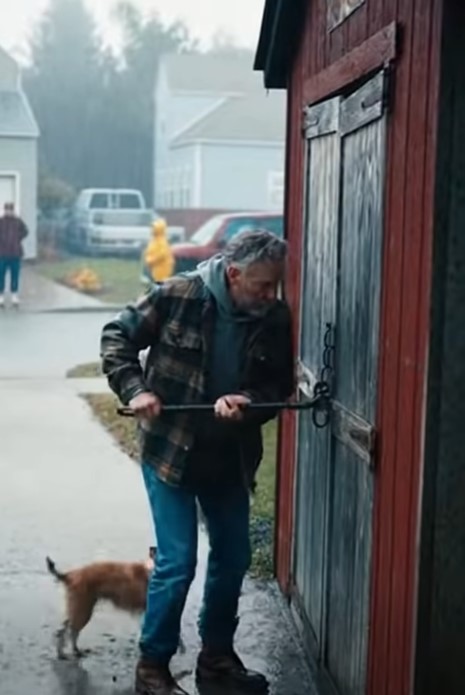
Arthur finally grabbed a flashlight and an old crowbar, deciding to follow.
The terrier led him through the wet grass straight to the shed. The scratching intensified as they approached. The door, once tightly sealed, now showed signs of repeated force from the inside. Arthur hesitated for only a moment before breaking the lock and pushing the door open.
Inside, the air was cold and damp.
In the corner of the shed, a teenage girl was curled up, weak, injured, and barely conscious. The terrier immediately ran to her side and refused to leave her. Arthur froze, overwhelmed by shock and confusion, unable to understand how someone had ended up there unnoticed for so long.
Before losing consciousness, the girl whispered a warning: she begged him not to call authorities directly, claiming that whoever was involved could monitor emergency communications. Her fear was immediate and deeply personal, suggesting she had been running from someone powerful or dangerous.
Arthur quickly realized this was no ordinary accident.
The girl identified herself as Lily Keller, the sixteen-year-old daughter of Chief Thomas Keller, a well-known law enforcement figure in the region. Her condition was serious, and she insisted she had been hiding because she feared her father would find her first. She also claimed she possessed evidence stored on a hidden USB drive—evidence connected to the suspicious death of her mother years earlier.
According to her, her father had covered up the truth.
Arthur found himself trapped between urgency and uncertainty. The situation was now larger than a simple rescue; it involved allegations of corruption, danger, and a life hanging in the balance. He knew he needed medical help, but Lily’s fear made every decision more complicated.
Arthur contacted Dr. Elias Thorne, an old friend who had once worked as a surgeon before leaving the medical field. Elias arrived quickly with emergency supplies and treated Lily inside the house as best as he could under the circumstances. He warned Arthur that her condition required immediate hospital care, possibly including a blood transfusion.
Before they could decide the next step, headlights appeared outside.
Multiple police vehicles arrived at Arthur’s property. Chief Keller himself was among them, along with several officers. The tension escalated instantly as Keller demanded custody of his daughter, insisting she was mentally unstable and in danger to herself and others.
Arthur refused.
He confronted Keller directly, mentioning the USB drive and questioning the official version of events surrounding Lily’s mother’s death. The situation became increasingly volatile as both sides stood their ground.
At that moment, Officer David Miller arrived separately after Arthur had managed to contact him quietly. Miller assessed the situation and began recording everything with his body camera. As he listened to both sides, it became clear that Keller’s version of events did not align with what was unfolding in front of him.
Backup from state authorities was already on the way.
When Keller attempted to take control of the situation, Miller ordered him to stand down. The confrontation ended with Keller being taken into custody for further investigation. Paramedics arrived shortly afterward and transported Lily for emergency treatment.
Six months later, Arthur’s life looked completely different.
The old shed was demolished, and in its place stood a small garden filled with lavender and marigolds—a quiet tribute to Martha’s memory and the unexpected chain of events that followed her loss. Lily survived, though her recovery required time, patience, and ongoing medical care. She learned to walk again with the help of a brace and gradually rebuilt her strength.
Arthur became her legal guardian.
The stray terrier, now named Buddy, never left her side.
What began as a lonely existence marked by grief slowly transformed into something new. The house that once felt empty now carried sound, movement, and purpose again. Arthur never planned to care for anyone again—not a child, not an animal, not even himself in any meaningful way.
But life had other plans.
Sometimes rescue does not arrive in an obvious form. Sometimes it comes quietly, through a storm, in the shape of a stray dog that refuses to leave. And sometimes, that small act of persistence can change multiple lives forever.
