Raising my twelve-year-old son Leo alone after the death of his father three years ago has been one of the most emotionally complex experiences of my life. In the early months, grief seemed to settle over our home like a permanent silence. Leo, once curious and talkative, gradually became withdrawn, answering questions with short phrases and spending long hours alone in his room. I often worried that I was watching him disappear into himself, unsure how to reach a child who no longer expressed what he felt.
Every attempt to comfort him seemed to fall short of where the pain actually lived. Everything began to change when Leo came home one afternoon visibly upset about his close friend Sam. Sam, who had used a wheelchair since early childhood due to a physical disability, had been excluded from a six-mile school hiking trip. The school had explained that the terrain was too steep and uneven for safe wheelchair access, and the decision was made for his safety.
Leo, however, saw only exclusion. In his mind, safety should not mean separation from everyone else, especially not from something meant to be shared. That Saturday, when the school buses returned, I immediately noticed Leo’s appearance. His clothes were covered in dried mud, his shoes heavily worn, and his breathing slow as if he had pushed himself far beyond his limits.
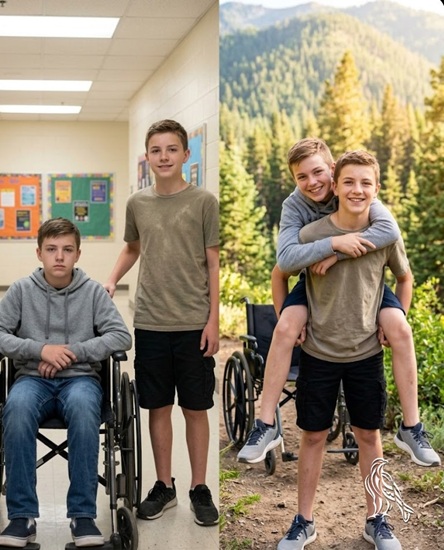
At first, I thought something had gone wrong with the trip, but the truth quickly became clear. Leo had carried Sam on his back for most of the hike after realizing Sam would not reach the summit otherwise. When the terrain became too difficult for the wheelchair and too risky for assistance, Leo made a decision that no one had anticipated.
According to what he later explained, he refused to leave Sam behind at the base camp. Instead, he helped him onto his back and continued forward, step by step, through narrow paths and steep inclines. There were moments when the trail became dangerously uneven, and he had to slow down or adjust his route entirely. He avoided areas where teachers might stop them, not out of defiance alone, but because he was determined that Sam would not miss what everyone else was experiencing. For Leo, the goal was simple: if the mountain could be reached, then Sam would reach it too.
When I met the school staff, Mr Dunn, the teacher in charge, expressed immediate concern. He was visibly frustrated, explaining the risks involved and how Leo had disregarded instructions meant to keep all students safe. He emphasized that such actions could have led to serious injury for both boys. While I understood his perspective as an educator responsible for dozens of children, I also found myself seeing something deeper in Leo’s actions—something rooted not in rebellion, but in loyalty and empathy that had been missing for a long time.
The following morning, I was urgently called back to the school. I expected a formal disciplinary meeting, perhaps even suspension. Instead, I was surprised to see several uniformed military officers standing outside the administration building. Inside the office, Leo was sitting quietly, visibly nervous, his eyes red from crying. He believed he was about to be severely punished. The atmosphere was heavy with anticipation, and even the staff seemed uncertain about what was about to happen.
One of the officers, Lieutenant Carlson, introduced himself and explained the reason for their visit. Sam and his mother, Sally, soon arrived as well. They shared how meaningful the experience had been for Sam, who had spent years imagining what it would feel like to reach the top of a mountain like the other children. For him, that day represented more than a school trip—it was a moment of inclusion he had long thought impossible. Sally also shared that Sam had recently lost his father, Mark, a military general who had served alongside some of the officers present.
The officers then explained that Leo’s actions had deeply resonated with them because they reflected a principle they valued in military service: never leaving someone behind. What Leo had done was not viewed as disobedience in their eyes, but as an act of extraordinary loyalty and determination. Instead of discipline, they had come to recognize character. Lieutenant Carlson presented Leo with a scholarship opportunity funded by a veterans’ organization, intended to support his future education as a recognition of his courage and integrity.
Another officer, Reynolds, removed a patch from his uniform and placed it gently into Leo’s hands as a symbolic gesture of respect. It was not a reward for breaking rules, but an acknowledgment of the intention behind his actions. Watching the moment unfold, I saw Leo in a way I hadn’t seen since before his father’s death—not as a child weighed down by grief, but as someone capable of decisive compassion.
As Leo and Sam embraced afterward, the atmosphere in the room shifted from tension to something quieter and more human. In that moment, I understood that something inside my son had changed. He was still quiet, still thoughtful, but no longer defined by emotional withdrawal. Instead, he had begun to express himself through action, through choices that reflected what he believed was right, even when it was difficult.
Walking out of the school that day, I realized I was no longer just watching my son grow up. I was watching him become someone shaped by loss, empathy, and responsibility. And while I could not erase the pain that had brought us here, I could see that he was learning how to carry it in a way that gave it meaning rather than silence.
