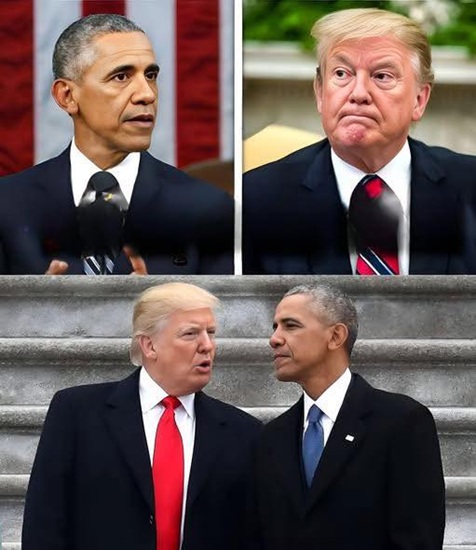
What began as a standard cable interview quickly evolved into something far more revealing about the state of modern political communication. In a controlled studio setting, with cameras rolling and producers carefully managing timing and flow, the expectation was a familiar exchange of talking points and moderated disagreement. Instead, what unfolded was a sharper, more unfiltered moment that immediately escaped the boundaries of the broadcast itself and entered the wider digital ecosystem within seconds.
Donald Trump’s remarks about Barack Obama were not delivered in isolation. They were framed in a way that felt both spontaneous and deliberate, as if designed for multiple audiences at once. On television, the exchange appeared as a direct critique of a former president. Online, however, it became something larger—a fragment of a broader narrative that supporters and critics could interpret in entirely different ways depending on their existing political views.
Supporters of Trump responded almost instantly, praising the remarks as candid and unrestrained, a contrast to what they often describe as overly polished political language. For them, the moment reinforced a sense that he was speaking without filters, rejecting traditional political caution in favor of direct confrontation. Critics, on the other hand, viewed the same moment as unnecessarily divisive, arguing that it contributed to a political climate already defined by tension and polarization.
Within minutes of the interview airing, clips began circulating across social media platforms. Short segments were reposted, replayed, slowed down, and dissected frame by frame. Every pause, emphasis, and facial expression was analyzed for hidden meaning. What had been a few minutes of conversation in a studio setting was transformed into a series of viral fragments, each carrying its own interpretation and emotional charge.
But beyond the immediate reactions, the moment highlighted a deeper structural shift in how political discourse now operates. Traditional television interviews once existed as self-contained events, consumed in real time and interpreted through full context. Today, however, those same interviews are absorbed into a continuous digital cycle where context is often stripped away, and isolated statements take on a life of their own.
This fusion of live broadcasting and social media amplification has created a new kind of political environment—one where attention is fragmented, and meaning is constantly reconstructed by audiences. In this space, a single sentence can overshadow an entire conversation, and a brief reaction can define public perception more strongly than hours of policy discussion.
Analysts observing the exchange noted that the significance of the interview did not lie solely in what was said, but in how quickly it was distributed and reinterpreted. The speed of reaction has become as important as the content itself. Within moments, commentary threads, opinion segments, and reaction videos began shaping the narrative in multiple directions simultaneously, each reinforcing different interpretations of the same event.
The incident also underscored how political communication has increasingly shifted toward performance. Interviews are no longer just exchanges of information between interviewer and guest; they are now strategic moments designed with awareness of secondary audiences watching through clips, highlights, and algorithm-driven feeds. Every statement exists not only for the people watching live, but also for the unseen audience that will encounter it later in edited form.
In this context, Trump’s criticism of Obama became more than a simple reference to past political disagreements. It functioned as a focal point for broader debates about leadership, legacy, and political identity. For some viewers, it reaffirmed long-standing beliefs about accountability and political contrast. For others, it reinforced concerns about escalating rhetoric and the erosion of traditional norms of political discourse.
What made the moment particularly significant was not its content alone, but its amplification. The interview did not remain confined to a single platform or audience. Instead, it spread across multiple digital channels, each reshaping it slightly through commentary, headlines, and user interpretation. This layered distribution created a feedback loop in which reaction fueled visibility, and visibility fueled further reaction.
As the discussion expanded, it became increasingly clear that the interview was part of a larger pattern in contemporary politics. Public figures now operate within an environment where every statement is potentially global within minutes, and where the distinction between news, commentary, and entertainment is increasingly blurred. In such a system, control over narrative is difficult to maintain, and meaning often shifts depending on who is sharing the content and how it is framed.
The broader implication of the moment lies in its reflection of how political reality is constructed today. It is no longer shaped solely in legislative chambers or formal speeches, but also in comment sections, short-form videos, and algorithm-driven feeds that prioritize engagement over nuance. As a result, political identity is increasingly formed through fragments rather than full narratives.
Ultimately, the interview served as a reminder of how quickly political communication can transform once it leaves the controlled environment of traditional media. What begins as a structured conversation can become a global discussion within minutes, shaped as much by digital reaction as by original intent. In this evolving landscape, understanding politics requires not only listening to what is said, but also recognizing how and where it is repeated, reframed, and reinterpreted.
