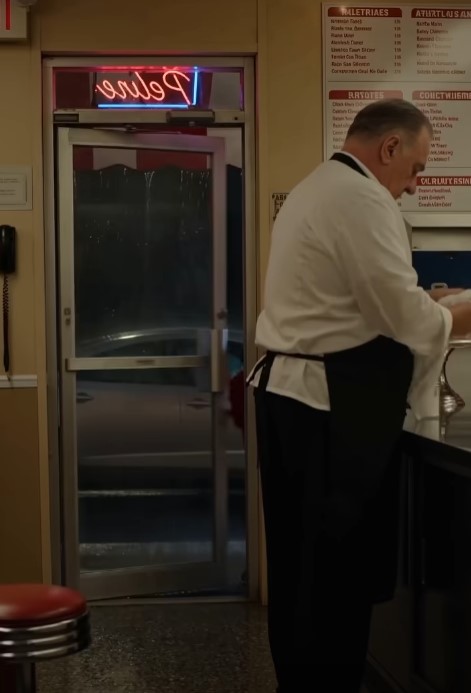
On a quiet, rain-soaked evening, a small roadside diner sat glowing under flickering neon lights, offering warmth to the few travelers who had taken shelter inside. The sound of steady rain hitting the windows created a constant rhythm, blending with the soft hum of conversation and the occasional clink of coffee cups. Nothing about the night suggested anything unusual—until a sudden moment changed everything inside that small space.
The waitress moved toward the entrance with hesitation, her hand trembling slightly as she turned the lock on the front door. The small metallic click sounded unusually loud against the backdrop of the storm outside. For a brief moment, the entire diner seemed to pause, as if sensing that something outside the glass carried more weight than just another passing stranger in the rain.
Outside, a man stood under the dim light of the streetlamp, his dark coat soaked from the storm. He did not move at first, only staring through the fogged glass with a tense, unreadable expression. One of his hands remained partially hidden inside his jacket, causing an immediate sense of unease among those inside. The people in the diner instinctively grew silent, watching and waiting.
Behind the counter, a young boy clung tightly to the cook’s apron, his small hands trembling as he tried to stay hidden. His breathing was uneven, and it was clear he had been frightened long before he ever entered the diner. The cook, a broad-shouldered man with calm but serious eyes, instinctively placed himself between the child and the locked door, as if shielding him without needing to think about it.
The man outside finally spoke, his voice muffled through the glass but firm enough to carry inside. He demanded the door be opened. The tension in the room immediately deepened. Chairs shifted slightly, and a few customers looked at one another, unsure of what was about to happen. The cook did not move away from the boy.
Instead, he stepped forward and stood his ground. His voice was steady but sharp as he responded, refusing the demand. The atmosphere inside the diner changed completely in that moment. What had once been a quiet shelter from the storm now felt like a place holding its breath in the face of danger.
From behind the cook, the boy’s voice broke the silence in a whisper that carried more weight than anyone expected. He said something that made several customers freeze in shock. The words suggested that the situation was far more serious than it first appeared, and immediately shifted the attention of everyone in the room toward the man outside.
The man’s expression tightened, but instead of reacting with aggression, he slowly withdrew his hand from inside his coat. There was no weapon, only a folded photograph. He pressed it against the glass, signaling for them to look. Reluctantly, the cook approached and took it, studying it under the dim interior light.
The photograph showed a woman, clearly distressed, holding a handwritten sign with a location that matched the diner. The image suggested urgency and confusion rather than clarity. But what caught the cook’s attention was not just the woman—it was a small, almost unnoticeable detail in the background. A mark he recognized from years ago, tied to a memory he had never fully forgotten.
The realization shifted the mood inside the diner once again. The cook’s expression hardened, not with fear, but with recognition and understanding. He looked back at the boy, then toward the man outside, reassessing everything he thought he knew in a matter of seconds.
Outside, the storm continued to pour heavily, but the situation was no longer just about the rain or the locked door. The cook stepped closer to the glass and spoke in a lower, more controlled voice, signaling that the man had entered a situation far more complicated than he realized. The energy inside the diner shifted from fear into determination.
Moments later, headlights began to fill the windows. Several vehicles arrived outside, their beams cutting through the rain and illuminating the entire parking lot. The presence of reinforcements changed the dynamic instantly. The man outside no longer held the same composure, and for the first time, uncertainty appeared in his expression.
Inside, the cook remained firmly in place, ensuring the child stayed behind him and out of sight. The waitress did not move from her position near the door, still holding the key tightly in her hand, ready to act if needed. The other customers remained seated, but alert, aware that they were now part of something much larger than an ordinary night.
The tension slowly began to shift as it became clear that control of the situation was no longer in the hands of the man outside. The diner, once a simple stop for food and shelter, had transformed into a place of protection and unity. Strangers had become a temporary shield for someone who needed safety the most.
In the end, what defined the night was not fear, but the quiet courage of those who chose to act. The cook’s decision to stand firm, the waitress’s instinct to secure the door, and the collective awareness of everyone inside turned an ordinary stormy evening into a moment of shared responsibility.
The boy, still shaken but safe, remained close to the cook, unaware of how many decisions had been made in his defense within such a short span of time. And as the rain continued to fall outside, the diner stood as a reminder that even in the darkest and most uncertain moments, people can choose to protect one another without hesitation.
