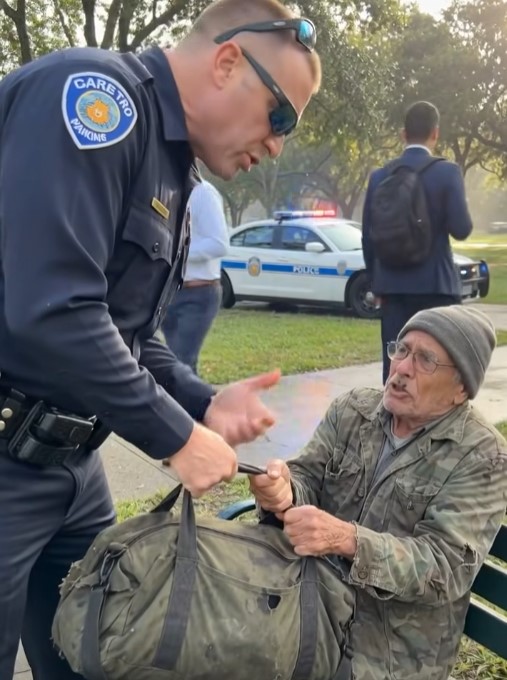
In the early hours of a seemingly ordinary morning, Miller Park was already alive with the rhythm of daily urban movement. Commuters crossed paths with joggers, students hurried toward buses, and city workers moved through familiar routes shaped by routine. Nothing about the atmosphere suggested that this particular morning would stand out from any other. Yet within that ordinary flow of life, a moment was unfolding that would quietly shift the attention of those who witnessed it and later ripple through the surrounding community in unexpected ways.
Silas was among those moving through the park that morning, following a familiar route toward his workplace. Like many others, he was focused on time, schedule, and the structure of his day. However, as he passed through a section of the park near a green iron bench, something disrupted that sense of routine. A police cruiser stood parked nearby, drawing attention to an interaction taking place between an officer and an older man seated near the bench.
That moment, though quiet and controlled on the surface, carried a deeper tension that was immediately noticeable to anyone paying attention. The man on the bench was known in the area simply as Sam. For years, he had been a consistent presence in Miller Park.
Most people recognized him visually—his worn clothing, his weathered appearance, and the small collection of belongings he carried with him. Despite being familiar to regular park visitors, he remained largely unseen in a meaningful sense. People acknowledged his presence but rarely engaged with his story. He had become part of the background of the park, visible but overlooked.
That morning, Officer Miller was reportedly informing Sam about a city ordinance being enforced more strictly. The rule restricted sleeping in public parks during specific hours of the day, and it required individuals in violation to relocate. For Sam, this meant he was being asked to leave the only consistent space he had occupied for an extended period. The situation was not framed as confrontation, but as enforcement of policy. Still, the emotional weight of the moment was difficult to ignore.
From a distance, Silas observed the interaction and immediately sensed that it was more than a routine enforcement action. Sam appeared physically tired and emotionally strained, carefully gathering his belongings while trying to process what he was being told. His duffel bag, blanket, and personal items represented not just possessions, but the only sense of stability he had maintained. Around them, life in the park continued as usual, with most passersby offering only brief glances before moving on.
Rather than continuing past the scene, Silas made the decision to stop. That choice marked the beginning of a shift in the direction of the entire morning. Instead of remaining an observer, he approached the bench and introduced himself to Sam in a calm and respectful manner. There was no confrontation, no attempt to challenge authority, and no public disruption. Instead, there was presence—simple, direct, and human.
In that moment, Silas offered something unexpected: an invitation to breakfast. It was not framed as charity or intervention, but as a shared meal. He explained that he was heading to eat and did not want to go alone. This simple gesture altered the emotional tone of the situation entirely. Where there had been tension and uncertainty, there was now a moment of pause, offering Sam an alternative experience to what he was facing.
At first, Sam hesitated. Years of instability had taught him caution, and leaving his belongings even briefly felt risky. However, Silas reassured him that everything would remain secure and that nothing would be lost. Slowly, trust began to form between the two men. Eventually, Sam agreed, and together they walked toward a nearby diner just a few blocks away, stepping out of the public space and into a quieter environment.
The restaurant, a modest local diner known for its early morning crowd, became the setting for what would develop into a far more significant interaction. Upon entering, the contrast between the busy interior and Sam’s condition was noticeable. While others in the room continued their meals and conversations, Silas guided Sam to a booth and ordered a full breakfast. The meal itself was simple, but the act of being seated, served, and acknowledged carried emotional significance that extended beyond food.
As they ate, conversation began to unfold naturally. Sam gradually became more open, sharing fragments of his experience and his past. At one point, he asked Silas a question that revealed recognition—wondering if he had served in the military. That moment established a shared understanding between them, creating a connection built on mutual respect rather than circumstance alone. Silas confirmed his background, and from that point, the conversation deepened.
What followed was not only dialogue, but action. While still at the table, Silas began reaching out to individuals within his personal and professional network. His first contact was with a veteran community leader who had experience organizing support systems for individuals in crisis. The urgency of the situation was clearly communicated, and immediate coordination began. Additional calls followed, including outreach to veteran housing specialists and individuals capable of providing rapid material support.
Within a short period of time, what began as a private breakfast evolved into a coordinated community response. Plans for emergency housing placement were explored, while logistical arrangements for furnishing and preparing a living space began to take shape. Each participant in the network contributed a specific role, transforming what had been an isolated situation into a structured support effort.
As the morning progressed, awareness within the diner grew. Observers began to sense that something unusual was taking place, not because of spectacle, but because of the seriousness of the interaction. Sam, who had spent years being largely unnoticed, was now the center of coordinated attention aimed at improving his circumstances. For the first time in a long while, he was not being moved along or ignored—he was being actively considered.
The emotional turning point of the morning came when Sam expressed what affected him most deeply. It was not the promise of housing or financial assistance, but the simple act of someone sitting with him, sharing time, and acknowledging his presence as meaningful. That moment reframed the entire situation, highlighting that human connection often carries more weight than immediate material solutions.
By the end of the day, discussions had progressed toward securing temporary housing placement and preparing a safe living environment. The goal was not only to provide shelter, but to restore a sense of dignity and stability. Coordinated efforts continued beyond the breakfast itself, involving outreach professionals, family support systems, and practical logistical planning.
What happened in Miller Park that morning ultimately reflected a broader truth about urban life and social visibility. Many individuals experiencing hardship remain physically present in public spaces while being emotionally and socially unseen. Their stories often go unnoticed not due to absence, but due to the speed and focus of everyday life around them.
In this case, however, one decision interrupted that pattern. A moment of attention became a moment of action, and that action expanded into a network of support. The transformation did not begin with resources or systems, but with presence—one person choosing to stop, sit down, and engage.
In the end, the significance of that morning was not limited to a single intervention or outcome. It served as a reminder of how quickly circumstances can shift when empathy is translated into action. Sam’s situation moved from isolation toward support, not through a single solution, but through a chain of human decisions grounded in awareness and responsibility.
What began as a routine morning in Miller Park became a story about visibility, dignity, and the quiet power of choosing to see someone who has long been overlooked.
